

Everything US businesses need to know about climate risk from definitions to disclosure obligations.
Before the season kicks off, American football coaches have already planned for injuries, bad weather, and a rival team’s unexpected form. Not because they enjoy the paperwork — because in a sport where one play changes everything, being caught off guard is just a loss waiting to happen.
Climate risk works the same way. Except the storm disrupting your game might also flood your warehouse, strand your supplier, or make your coastal assets uninsurable, on a global scale.
The playbook exists. Most businesses just haven’t opened it yet. And that playbook starts with understanding what climate risk actually is.
Climate risk refers to the financial and operational exposure businesses face from two sources: the direct impacts of a changing climate — including extreme weather events and long-term shifts — and the economic disruption that comes with transitioning to a lower-carbon economy.
Before you read further, here’s a ready reckoner you can use to assess your own climate risk exposure.
For businesses, climate risk is not only an environmental question but a balance sheet question too. Understanding it is the first step toward managing it and increasingly disclosing it.
Spend 10 minutes with us, and here’s what you’ll walk away with:
- A clear understanding of physical and transition climate risk
- How climate risk translates into financial exposure on your balance sheet
- The frameworks regulators and investors are using to assess it
- A practical starting point for your own climate risk assessment
The Two Main Types of Climate Risk: Physical and Transition
Climate risk isn’t one thing. It comes from two distinct directions, and most businesses are exposed to both, even if they don’t realize it yet.
The first is physical climate risk: the direct impact of a changing climate on your assets, operations, and supply chains. The second is transition climate risk: the financial and business disruption that comes from the world shifting toward a lower-carbon economy — through policy, technology, markets, and litigation.
Both types are real. Both are already moving. And both, left unmanaged, find their way onto your balance sheet.
Here’s how they compare:
| Physical Climate Risk | Transition Climate Risk | |
| What it is | Harm from climate hazards — events and long-term shifts | Risk from the economic shift to a low-carbon economy |
| Types | Acute (sudden events) and chronic (long-term shifts) | Policy, technology, market, reputation and litigation |
| Examples | Hurricanes, wildfires, floods, sea level rise, drought | Carbon pricing, EV mandates, stranded assets, greenwashing suits |
| Who feels it most | Asset-heavy industries, real estate, agriculture, logistics | Energy, manufacturing, auto, financial services |
| Time horizon | Now and accelerating | Already underway, intensifying through 2030s |
Climate change impacts harm virtually every sector, but exposure varies significantly. Asset-heavy industries — manufacturing, logistics, and real estate — face the sharpest physical risk. Energy companies and financial institutions carry the heaviest transition risk load. Understanding which risks are most material to your sector is the starting point for everything that follows.
CREDIBL HOT TAKE: Awareness is rarely the problem. Most leadership teams can name the risks. What they struggle to produce is a number. A defensible, asset-level view of what those risks actually cost them. That is the work most organizations haven’t done yet.
The next two sections break each type down in detail. After that, we’ll show you exactly how both translate into financial risk, the part your board and your lenders are increasingly paying attention to.
What is Physical Climate Risk?
Physical climate risk is exactly what it sounds like: the risk that climate-related events and shifts cause direct harm to your business. It shows up in damaged facilities, disrupted supply chains, stranded assets, and rising insurance costs. Physical climate risk is not just a future concern. For many businesses, it is already showing up in the numbers — in write-offs, unplanned capex, and higher insurance premiums.
Physical risks fall into two categories, acute and chronic.
Acute Physical Risks
Acute risks are sudden, event-driven, and often devastating in the short term. These extreme weather hazards — hurricanes making landfall along the Gulf Coast, wildfires tearing through California and Oregon, flash floods disrupting logistics corridors, extreme heat pushing energy infrastructure to breaking point — are increasing in both frequency and severity.
For a distribution warehouse in Florida’s flood zone, one major storm event can mean weeks of lost operations, damaged inventory, and an insurance claim that may not be fully covered. For a data center in Texas, a heatwave of the kind seen in 2023 is not a weather anomaly. It is an operational risk that belongs in the board report.
For many kinds of extreme weather, frequency and severity are already increasing, and businesses are starting to feel those impacts in real time.
Chronic Physical Risks
Chronic risks are slower moving but in many ways more structurally dangerous. These are the long-term shifts driven by climate science — rising seas, changing precipitation patterns, ocean acidification affecting coastal and marine-dependent supply chains — that quietly erode asset values, supply chain reliability, and business model assumptions over years and decades.
Sea level rise is making coastal commercial real estate increasingly difficult to insure and finance. Shifting precipitation patterns are disrupting agricultural supply chains across the Southwest. Rising average temperatures are changing energy demand profiles, labor productivity in outdoor industries, and the viability of water-intensive operations.
The challenge with chronic risks is that they don’t trigger a single loss event. They just gradually make your assumptions wrong.
Asset-Level vs Portfolio-Level Exposure
Understanding physical climate risk at the asset level means asking: is this specific facility, in this specific location, exposed to flood, fire, heat, or water stress? That is the starting point.
But portfolio-level exposure is a different and more complex question. A CFO managing 40 facilities across the Sun Belt, or a lender with real estate collateral spread across coastal markets, needs to understand aggregate exposure across the entire portfolio, not just individual assets. The risks can cluster in ways that aren’t visible until you map them.
This is where climate risk assessment moves from a sustainability exercise to a risk management one. We come back to how that works in practice, later in this blog.
What is Transition Climate Risk?
Physical climate risk comes from nature. Transition climate risk comes from people — specifically, from the collective decision to move the global economy away from carbon.
Policy shifts, technology disruption, changing customer behavior, and litigation are all part of it. And unlike a hurricane, transition risk doesn’t announce itself with a weather warning.
Policy and Regulatory Risk
Carbon pricing mechanisms, emissions caps, and mandatory climate-related disclosure requirements — including regulatory reporting obligations under SB 261 and IFRS S2 — are expanding the compliance surface faster than most risk functions have mapped.
California’s SB 261 requires companies with over $500 million in revenue doing business in the state to disclose climate-related financial risks, with initial reporting currently expected from 2026, subject to ongoing legal and implementation developments.
The SEC’s climate disclosure rule, though currently stayed in court, has already shifted investor expectations. IFRS S2 is emerging as a baseline for what good climate-related disclosure looks like and is increasingly referenced by institutional investors and regulators in multiple markets.
Companies that haven’t mapped their regulatory exposure aren’t just behind on compliance. They are accumulating climate change risks that will eventually need to be priced — and losing the ability to make informed decisions before those costs land.
Technology Disruption Risk
The transition to a lower-carbon economy is not just a policy story. It is a technology story, and the disruption is already repricing assets.
EV mandates are reshaping auto supply chains from tier-one suppliers down. The clean energy transition is turning fossil fuel reserves into stranded assets on balance sheets that were built around a different set of assumptions.
Companies that move early on capital reallocation — investing in technology development and reducing emissions ahead of mandate — tend to absorb these shifts. Companies that wait tend to absorb write-downs instead.
Market and Revenue Shift Risk
Customer preferences are moving. Large enterprise buyers are increasingly requiring emissions data from suppliers as a condition of doing business.
Consumer-facing brands are under growing pressure to demonstrate credible progress on carbon, not just commitments.
The revenue risk here is real and it compounds quietly. A manufacturing company that loses a key customer contract because it can’t provide Scope 3 data doesn’t always connect that loss back to climate risk. But that is exactly what it is.
Reputation and Litigation Risk
Greenwashing and other climate-related litigation are increasing in the US and other major markets.
Directors’ and officers’ liability is expanding into climate territory, with shareholders and regulators increasingly willing to pursue companies that overstate climate credentials or understate climate exposure.
This is a topic that deserves its own dedicated treatment, and we cover it in detail in our guide to climate-related litigation risk.
For now, the short version is this: What you say publicly about climate risk, and what you actually know internally, need to be consistent. The gap between the two is where litigation lives.
CREDIBL HOT TAKE: Transition risk catches companies off guard not because it’s sudden, but because it’s cumulative. A regulatory change gets logged by legal. A customer requirement gets handled by procurement. A litigation filing gets picked up by compliance.
Nobody is looking at all four categories together and asking: What is our aggregate exposure? That fragmented approach is exactly where most financial surprises come from.
How Climate Risk Becomes Climate-Related Financial Risk
Understanding climate risk as a concept is one thing. Understanding where it shows up on your balance sheet is another.
This is the section your CFO, your lender, and your board are most interested in — because this is where climate stops being an environmental conversation and starts being a financial one.
Climate-related financial risk is not a brand-new risk category. It is what happens when physical and transition climate risks flow through into your existing financial risks and statements.
Here, we have grouped those effects into five main channels.

Revenue Impact
Acute weather events can disrupt operations and cut revenue. A flood that shuts down a distribution centre for three weeks doesn’t just create a repair bill. It creates a revenue gap, a customer service problem, and potentially a contract penalty.
Transition risks hit revenue differently — through customer churn, lost procurement contracts, and markets shifting away from carbon-intensive products faster than businesses can adapt.
Cost Exposure
Climate risk raises costs across multiple lines simultaneously. Insurance premiums are rising in high-risk geographies, and in some markets, coverage is becoming significantly more expensive or harder to obtain on viable terms.
Physical hardening of assets — flood barriers, cooling systems, backup power — requires unplanned capital expenditure. Compliance costs associated with disclosure frameworks and emissions reporting are adding to finance and legal workloads. Very few of these are one-time costs. Many of them compound over time.
Asset Valuation Risk
This is where climate risk becomes visible on the balance sheet in the most direct way. Coastal commercial real estate in high flood-risk zones is already facing insurance and lending pressure, and in many markets that is starting to feed through into valuations.
Fossil fuel assets are at risk of becoming stranded as transition policies tighten and demand shifts.
For any business carrying significant physical assets, the question worth asking is: What are these worth in a 2°C world versus a 4°C world? That requires running multiple climate scenarios — and the answer is rarely the same number.
Cost of Capital
Lenders and investors are increasingly taking climate exposure into account when they set terms, even if practices vary by market and asset class.
A company with unquantified physical risk across its asset base, or significant transition exposure in a regulated sector, is a different credit proposition than one that has mapped, disclosed, and is actively managing those risks.
TCFD-aligned disclosure is increasingly treated as a baseline expectation in many institutional debt and equity markets — not because investors have become environmentalists, but because unmanaged climate risk is a financial risk they are being asked to account for too.
Insurance Availability
This deserves its own line because it is no longer a theoretical risk. Insurers are withdrawing from, or sharply reducing exposure in, several high-risk geographies in the US.
Major carriers have already pulled back from parts of the California and Florida homeowner and commercial markets.
When insurance becomes unavailable or unaffordable, it affects property values, financing terms, and operational continuity simultaneously. For businesses with significant physical footprint in exposed geographies, insurance availability is a leading indicator worth tracking now, not after renewal season.

Frameworks Used for Climate Risk Assessments and Disclosure
If physical and transition risks are the problem, frameworks are the shared language businesses and regulators use to assess, measure, and communicate them.
There are several in circulation. Some are voluntary. Some are becoming mandatory. Some are both, depending on where you operate and who your investors are.
Here are the five frameworks most relevant to US businesses right now.
TCFD — Task Force on Climate-related Financial Disclosures
TCFD is where most of the modern climate disclosure architecture starts. Established by the Financial Stability Board in 2015, it organizes climate-related disclosure around four pillars: governance, strategy, risk management, and metrics and targets. It was designed to give investors consistent, comparable, and decision-useful information about how companies are managing climate risk.
TCFD is no longer just a voluntary best practice framework. It has been embedded into mandatory reporting regimes in the UK, New Zealand, and several other jurisdictions. In the US, it remains the de facto reference point for institutional investor expectations and forms the backbone of both the SEC’s proposed climate disclosure rule and California’s SB 261 requirements.
If you are building a climate risk disclosure for the first time, TCFD is the logical starting point.
IFRS S2 — Climate-related Disclosures
IFRS S2 is the international sustainability disclosure standard specifically focused on climate. Published by the International Sustainability Standards Board in 2023, it builds directly on TCFD and goes further, requiring companies to disclose climate-related risks and opportunities across both the near and long term, using scenario analysis to stress-test their climate resilience.
IFRS S2 is emerging as a baseline for what good climate-related disclosure looks like and is increasingly referenced by institutional investors and regulators in multiple markets.
For US companies with international operations, investors, or supply chain relationships, familiarity with IFRS S2 is becoming a practical necessity rather than an optional extra.
California SB 261 — Climate-Related Financial Risk Act
For US businesses, SB 261 is the most immediately actionable disclosure requirement on this list. It requires companies with over $500 million in annual revenue doing business in California to prepare and publish a climate-related financial risk report, disclosing both their material climate risks and the measures they are taking to address them.
Reports are expected to be aligned with TCFD or an equivalent framework, with initial reporting currently expected from 2026, subject to ongoing legal and implementation developments.
Given California’s economic scale — if it were a country, it would be the fifth largest economy in the world — SB 261 has effective reach, well beyond state borders.
NGFS Scenarios — Network for Greening the Financial System
The NGFS is a network of central banks and financial supervisors that has developed a set of climate scenarios widely used for financial risk assessment. Where TCFD tells you what to disclose, NGFS scenarios give you the analytical inputs to do it — specifically, a range of transition pathways from orderly decarbonization through to high physical risk outcomes.
For finance teams and risk functions running scenario analysis, NGFS scenarios are the standard toolkit.
They allow businesses to test how their assets, revenues, and costs hold up under different climate futures, from a world that hits net zero by 2050 to one that does not.
IPCC Scenarios — The Physical Risk Baseline
The Intergovernmental Panel on Climate Change publishes the scientific consensus on climate change, including the scenario pathways — known as SSPs and previously RCPs — that underpin physical risk modelling globally.
When a climate risk assessment asks what flood risk looks like at 1.5°C versus 3°C of warming, it is drawing on IPCC scenario data.
For businesses running physical risk assessments, IPCC scenarios are the scientific foundation. They are not a disclosure framework in themselves, but they are the basis on which credible physical risk analysis is built.
How to Conduct a Climate Risk Assessments
Knowing what climate risk is gets you to the starting line. Actually managing it requires a structured process. The good news is that the process is not as complicated as the frameworks make it look. It follows a logical sequence, and most of it builds on risk management disciplines your business already has.
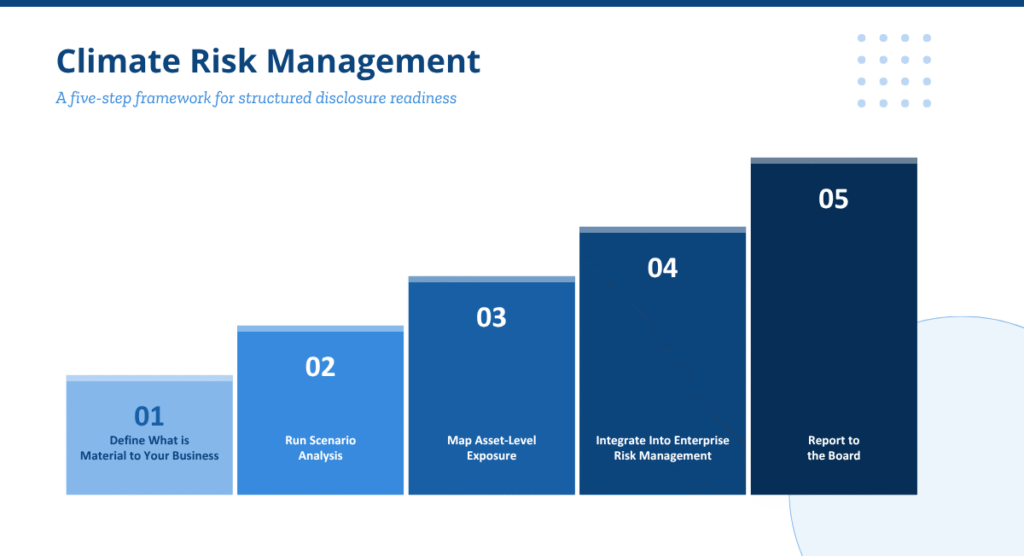
The process, broken down, looks like this:
Step 1 — Define What is Material to Your Business
Not every climate risk is relevant to every business. A technology company with a largely remote workforce and no physical manufacturing footprint faces a fundamentally different risk profile than a logistics company operating warehouses across the Gulf Coast.
Materiality in climate risk means identifying which physical and transition risks are actually significant enough to affect your business model, your asset base, your revenues, or your cost structure.
This step is about narrowing the universe of possible risks down to the ones that genuinely matter for your specific situation.
It is also the foundation on which everything else is built. Run scenario analysis before you have defined materiality and you are modelling the wrong things.
Step 2 — Run Scenario Analysis
Scenario analysis is the core analytical tool of climate risk assessment. It asks a simple question with complex answers: How does our business hold up under different climate futures?
In practice, this means testing your exposure under at least two contrasting scenarios. A low-physical-risk scenario — where the world decarbonizes relatively quickly and transition risks are higher — and a high-physical-risk scenario — where decarbonization is slow and physical climate impacts intensify.
NGFS scenarios cover the transition pathways. IPCC scenarios provide the physical risk inputs.
The output is not a prediction. It is a structured view of where your business is most vulnerable, and under what conditions. That is exactly what boards, lenders, and regulators are asking for.
Credibl’s climate risk tool connects scenario inputs directly to your asset base delivering actionable insights and a decision-ready risk view, not a manual spreadsheet exercise.
CREDIBL HOT TAKE: Scenario analysis is where most climate risk programmes stall. The frameworks exist. The scenarios are published. But taking those outputs and translating them into specific decisions about specific assets requires data infrastructure and cross-functional discipline that most organizations are still building. The ones that move fastest aren’t smarter. They’ve stopped trying to do it manually.
Step 3 — Map Asset-Level Exposure
Scenario analysis tells you what risks matter. Asset-level mapping tells you where they sit in your business.
This means getting specific: Which facilities are in flood zones? Which supply chain nodes are in water-stressed regions? Which revenue streams depend on assets or markets that are exposed to transition risk?
The granularity here matters. Aggregate exposure statements are useful for disclosure. But effective asset management requires asset-level maps — these are what actually drive risk management decisions and enable mitigating risk at the asset level before it reaches the balance sheet.
For businesses with large or geographically distributed asset bases, this step often surfaces concentrations of risk that were not visible at the portfolio level.
Step 4 — Integrate Into Enterprise Risk Management
This is the step most companies have not yet taken, and it is the one that matters most for governance.
Climate risk does not belong to a separate sustainability workstream, reviewed once a year by the ESG team and filed in the annual report. It belongs alongside credit risk, operational risk, and market risk in your enterprise risk management framework with the same ownership, the same escalation paths, and the same board visibility.
Integrating climate risk into ERM means assigning it a risk owner, setting thresholds, building it into risk appetite statements, and ensuring it is part of the regular risk reporting cycle.
Until that happens, climate risk assessment is an exercise. After it happens, it is a management process — one that can reduce greenhouse gas emissions exposure, build resilience, and protect long term resilience across the business.
CREDIBL HOT TAKE: This is the step that separates organizations genuinely managing climate risk from those managing the appearance of it. The difference shows up eventually in a credit review, an investor meeting, or a disclosure that doesn’t hold up to scrutiny.
Step 5 — Report to the Board
Board-level governance of climate risk is now an expectation, not a differentiator. TCFD, IFRS S2, and SB 261 all include explicit requirements around governance — specifically, that boards demonstrate oversight of climate-related risks and opportunities, and that management has clear responsibility for assessing and managing them.
In practice, this means the board needs to see climate risk in a format it can act on. Not a sustainability update.
A risk report with material risks identified, scenarios tested, asset exposure quantified, and management responses documented.
The quality of board reporting on climate risk is increasingly a signal that investors and regulators use to assess whether a company is genuinely managing it or just disclosing it.
Still have questions? Here’s what we hear most often.
Frequently Asked Questions About Climate Risk
What is the difference between physical and transition climate risk?
Physical climate risk refers to the direct harm caused by climate-related events and shifts — floods, wildfires, drought, sea level rise. Transition climate risk refers to the financial and business disruption that comes from the shift to a lower-carbon economy, through policy changes, technology disruption, shifting markets, and litigation. Most businesses face both, often simultaneously.
How is climate risk different from ESG risk?
ESG risk is a broad category covering environmental, social, and governance factors that can affect a company’s performance. Climate risk is a subset of ESG risk, sitting within the environmental pillar. The distinction matters because climate risk has its own dedicated disclosure frameworks, regulatory requirements, and financial transmission channels that go well beyond general ESG reporting.
Who needs to disclose climate risk in the US?
Currently, the clearest mandatory requirement for US businesses is California’s SB 261, which applies to companies with over $500 million in annual revenue doing business in the state. The SEC’s climate disclosure rule remains stayed in court as of 2026. Beyond mandatory requirements, institutional investors and lenders are increasingly expecting TCFD-aligned disclosure as a condition of doing business, regardless of whether a legal requirement applies.
What is a climate risk assessment?
A climate risk assessment is a structured process for identifying, analyzing, and prioritizing the physical and transition climate risks that are material to a specific business. It typically involves defining materiality, running scenario analysis using recognized frameworks such as NGFS and IPCC, mapping asset-level exposure, and integrating findings into enterprise risk management. The output is a clear picture of where a business is most vulnerable and under what conditions.
Which frameworks are used for climate risk disclosure?
The most widely used frameworks are TCFD, which provides the foundational disclosure structure, and IFRS S2, which builds on TCFD and is increasingly referenced by institutional investors globally. In the US, California’s SB 261 requires disclosure aligned with TCFD or an equivalent framework. For scenario analysis, NGFS and IPCC scenarios provide the analytical inputs underpinning most credible assessments.
What is climate-related financial risk?
Climate-related financial risk is what happens when physical and transition climate risks flow through into a company’s financial position. It shows up across five channels: revenue, costs, asset valuations, cost of capital, and insurance availability. It is not a separate category of risk — it is the financial expression of climate risk, and it is increasingly relevant to credit assessments, investor due diligence, and regulatory disclosure.
If you’ve made it this far, you now have a clearer picture of what climate risk is, where it comes from, and what it means for your business financially. The next question most teams ask is: where do we actually start?
Credibl’s Climate Risk Platform gives businesses like yours a structured starting point from materiality assessment to scenario analysis, asset-level exposure mapping, and board-ready reporting. It is built for the teams doing the work, not just the teams writing about it.