

The August 10, 2026 CARB deadline is under 90 days away.
And for most companies doing business in California, the hardest part of SB 253 compliance isn’t the Scope 1 and 2 filing. It’s building the Scope 3 supplier data infrastructure that will determine whether your emissions inventory survives a 2027 assurance engagement.
Choosing the wrong software now means a costly migration later.
| # | Platform | Pricing tier | Implementation time | GHG Inventory Coverage | Best for |
| 1 | Credibl ESG ⭐ | Mid-market to Enterprise | 8–12 weeks | Scope 1, 2, 3 · method escalation · 1 million emission factors · AI enabled GHG data management | Complex ESG data companies in sectors – manufacturing, chemicals, iron & steel, food industry, ecommerce, hospitality and others |
| 2 | Cority / Greenstone | Enterprise / Custom | Varies | Scope 1–3 · Arcadia partnership automates Scope 2 utility data · | Manufacturing, chemicals, energy with existing EHS infrastructure |
| 3 | IBM Envizi | Enterprise / Custom | Enterprise timelines | Scope 1–3 · standout Scope 2 · 40,000+ managed factors · automated market-based vs. location-based treatment | Enterprises on IBM infrastructure · real estate · energy-intensive operations |
| 4 | Persefoni | Mid-market to Enterprise | 8–16 weeks | Scope 1–3 · activity-based with hybrid fallback · strict GHG Protocol alignment · strong audit trail | US companies prioritising audit-ready reports · financial services · private equity |
| 5 | Salesforce Net Zero Cloud | Enterprise / Custom | Deployment-dependent | Scope 1–3 · GHG Protocol-aligned · SB 253, CSRD, GRI report builders · Scope 3 method depth varies by edition | Enterprises standardised on Salesforce integrating climate disclosures into existing workflows |
| 6 | Diligent ESG | Enterprise / Custom | 10–16 weeks | Persefoni powers the carbon layer · Scope 1–3 · two vendor dependencies | Listed companies managing board-level ESG governance alongside SB 253 |
| 7 | Optera | Mid-market | 6–10 weeks | Scope 1–3 · GHG Protocol-compliant · audit-oriented · limited multi-framework depth | Mid-market US companies ($1B–$3B revenue) wanting US regulatory focus |
| 8 | Sphera | Enterprise / Custom | Varies | Scope 1–3 · proprietary LCA data · strong Scope 1 for industrial operations | Manufacturing, chemicals, industrial enterprises with complex Scope 1 profiles |
| 9 | Sweep | Mid-market to Enterprise | 8–14 weeks | Scope 1–3 · SB 253, CSRD, ISSB, GRI, CDP from one dataset · strongest on supplier engagement | EU-US multinationals running CSRD and SB 253 on one platform |
| 10 | Watershed | Mid-market to Enterprise | 8–12 weeks | Scope 1–3 · spend-based to supplier-specific · activity-based depth among the strongest | Tech, retail, consumer with supplier-heavy Scope 3 footprints |
| 11 | Workiva | Enterprise / Custom | Varies | Hybrid carbon model: Scope 1–3 data via Persefoni connector or native Workiva Carbon module. | Finance-led programmes assembling audit-ready SB 253 filings |
This blog covers who needs to act, what four capabilities actually separate platforms in an assurance context, and which tools are worth shortlisting.
If your Scope 3 supplier engagement programme hasn’t started yet, note that the entire process takes 12–18 months to yield usable data.

Does California’s climate disclosure law apply to your company?
California’s climate disclosure laws cast a wide net. The California Air Resources Board approved the initial regulation at its February 2026 meeting, formally establishing definitions, fee structures, and the first-year reporting deadline under SB 253 and SB 261.
Before evaluating any SB 253 reporting software, the first question is whether your company is a reporting entity at all — and the answer is less straightforward than the headline revenue numbers suggest.
SB 253: The $1 billion threshold
SB 253, the Climate Corporate Data Accountability Act, requires US-based entities with more than $1 billion in annual revenue that do business in California to annually report Scope 1 and Scope 2 greenhouse gas emissions beginning in 2026, and Scope 3 GHG emissions beginning in 2027.
A reporting entity under SB 253 is a partnership, corporation, limited liability company, or other business entity formed under California law or the laws of any other state, the District of Columbia, or Congress, that does business in California and has revenues in excess of $1 billion in total global revenue.
Applicability is determined based on revenue from the prior fiscal year and not the current one.
An estimated 5,400 organisations are expected to fall within scope. That includes public and private companies, LLCs, and partnerships. Nonprofits, charities, and majority government-owned entities are exempt.
One nuance worth flagging for multi-entity groups: Parents can report on behalf of their subsidiaries, and a subsidiary included in a parent’s consolidated report does not need to submit its own report.
However, CARB will assess fees on each individual entity that meets the revenue threshold, regardless of whether it filed separately or was included in a parent’s consolidated report.
SB 261: The $500 million threshold and current enforcement status
For US-based entities with more than $500 million in annual revenue that do business in California, SB 261, the Climate-Related Financial Risk Act, requires a biennial report of their climate-related financial risks and measures adopted to reduce and adapt to those risks.
The reports must align with the Task Force on Climate-related Financial Disclosures (TCFD) framework, covering both physical and transition risks.
The enforcement picture for SB 261 is different from SB 253. The Ninth Circuit’s November 2025 injunction remains in effect following oral argument in January 2026. CARB has stated it will not enforce the January 1, 2026 deadline while the appeal is pending and will provide an alternate reporting date after it is resolved.
That does not mean SB 261 is off the table.
CARB earlier opened a public docket for entities that may choose to voluntarily submit their climate-related financial risk report under SB 261 in the interim. More importantly, any software evaluation you run today for SB 253 emissions reporting should account for SB 261 climate risk disclosure requirements — the injunction could lift at any point, and a platform that handles both laws on one data model avoids a costly second implementation later.
What “doing business in California” actually means
Yes, being headquartered outside California does not exempt you.
Under CARB’s adopted regulations, “doing business in California” means actively engaging in any transaction for the purpose of financial or pecuniary gain or profit, and either being organised or commercially domiciled in California, or having sales in California that exceed $757,070 (2025 inflation-adjusted figure) or 25% of the entity’s total sales.
CARB staff also indicated at the March 2026 workshop that corporate groups filing taxes as a unitary business should aggregate their revenues in determining whether they meet the relevant thresholds under SB 253 and SB 261 — meaning a parent-subsidiary structure does not automatically reduce your exposure.
In plain terms: If your company sells products or services into California, maintains any offices in the state, or has employees operating there, and your global revenue clears the applicable threshold, you are almost certainly in scope. The safer default is to assume applicability and confirm the exemption, not the other way around.
CARB emissions reporting requirements in 2026: Key deadlines
The regulatory timeline has crystallised considerably since early 2025. CARB’s initial regulation, adopted at its February 2026 board meeting, formally establishes the August 10, 2026 first-year reporting deadline based on stakeholder feedback. That date is now firm.
August 10, 2026: Scope 1 and 2 deadline
CARB confirmed at its March 2026 workshop that companies with fiscal years ending on or before February 1, 2026 will report FY 2025–2026 data, while companies with fiscal years ending after February 1, 2026 will report FY 2024–2025 data.
For the 2026 reporting cycle, CARB will not impose a standardised reporting template, nor will limited assurance be required. However, CARB has indicated it will prioritise compliance assistance and exercise enforcement discretion for companies making good-faith first-year submissions. The $500,000 annual penalty ceiling still applies — CARB’s flexibility is not an invitation to skip preparation.
What you need to submit: Scope 1 direct emissions from owned or controlled sources — facilities, manufacturing processes, vehicle fleets — and Scope 2 indirect emissions from purchased electricity, steam, heat, and cooling.
CARB requires granular reporting by emission source and by greenhouse gas type, covering CO₂, methane, nitrous oxide, and others. This is not a high-level estimate — detailed activity data and robust calculation methodologies aligned with the GHG Protocol are required.
Scope 3 and reasonable assurance: What’s confirmed vs what’s still in progress
Scope 3 reporting begins in 2027, with the specific framework currently in pre-rulemaking. CARB has proposed three approaches:
- Broad applicability across all 15 Scope 3 categories
- A sectoral phase-in prioritising transportation and industrial sectors, or a category-based phase-in starting with the most commonly reported categories including business travel, purchased goods and
- Services, fuel and energy-related activities, employee commuting, and waste generated in operations
On assurance, CARB proposed at its March 2026 rulemaking workshop that limited assurance for Scope 1 and 2 emissions would be required starting in 2027, under recognised standards including ISSA 5000, ISAE 3000/3410, AICPA AT-C 210/205, AA1000AS v3, and ISO 14064-3. Assurance requirements beyond 2027, including reasonable assurance, will be addressed in subsequent rulemaking.
The practical implication for software selection: The platform you choose today needs to handle not just your August 10 Scope 1 and 2 submission, but the Scope 3 data collection infrastructure, automated emissions calculations, and audit trail requirements that third-party assurance will demand from 2027 onward.
Switching platforms mid-programme — after you have already built a year of data history — is expensive and disruptive. Get the data management architecture right in the first year.
How to choose SB 253 reporting software: Four major capabilities that decide the platform fit
Most SB 253 software evaluations start in the wrong place. Teams run vendor demos, compare feature checklists, and score on breadth.
The real question is which platform will hold up when your auditor arrives in 2027 and won’t need replacing before reasonable assurance kicks in at the end of the decade.
Four capabilities determine that. Everything else is secondary.
Scope 3 depth across all 15 GHG Protocol categories
This is where most evaluations fall apart and the capability hardest to retrofit later.
Value chain emissions typically represent 70–90% of a company’s total carbon footprint and require 12–18 months to establish reliable baselines. Starting that data collection late means going into your 2027 assurance engagement with an immature Scope 3 inventory.
The platform must support all 15 GHG Protocol categories not a curated subset. More importantly, it needs method escalation i.e. the ability to move from spend-based calculations in year one to activity-based and supplier-specific data as your emissions accounting matures.
CARB’s March 2026 workshop proposed four GHG accounting methods: Spend-based, activity-based, supplier-specific, and hybrid. Platforms locked to spend-based only are already behind where regulators are heading — and won’t survive the reasonable assurance standard that applies to Scope 1 and 2 from 2030, and limited assurance for Scope 3 from the same year.
CARB-structured output, not just a PDF export
Ask your shortlisted vendors directly “Do you have a CARB submission format, or do we export to PDF and restructure manually?” The latter sounds manageable until you’re doing it at scale, under deadline, while your assurance provider is waiting.
CARB published a draft Scope 1 and 2 reporting template in October 2025 — voluntary for 2026, but a clear signal of where structured emissions reporting is heading. A platform already building against that template is better placed than one with CARB output on the roadmap.
Beyond CARB, the same underlying emissions data should produce outputs for SB 261’s TCFD climate risk disclosures, CDP, IFRS S2, and CSRD without recalculation. That multi-framework mapping is what separates purpose-built climate disclosure software from a single-framework tool that’s aged out of the current regulatory environment.
Transparent audit trail for third-party assurance
Limited assurance becomes mandatory from 2027, so start conversations with assurance providers early, as qualified providers need to be independent and market capacity is limited.
Assurance providers don’t just check the final number. They trace it back to the source — invoices, ERP data, or supplier inputs. If that evidence trail is slow to find, assurance delays and costs increase.
The capability to look for isn’t “data lineage” as a marketing phrase. It’s per-data-point traceability — every number timestamped, source-document linked, retrievable in a few clicks. The transition to reasonable assurance in 2030 typically doubles audit costs and requires significantly more robust internal controls. Companies that build audit-ready systems from day one avoid expensive retrofitting later.
The SOX analogy holds here. The emissions data management infrastructure you build now either holds up under scrutiny or it doesn’t.
Multi-framework mapping using one universal dataset
If you’re in scope for SB 253, you’re likely navigating CDP, ISSB/IFRS S2, CSRD, or BRSR simultaneously. Running separate emissions calculations per framework isn’t just inefficient — it’s a data integrity risk. Different numbers in different disclosures for the same underlying activity will be noticed by investors, auditors, and regulators.
The right platform runs SB 253 and SB 261 as parallel workflows on one data model. The same greenhouse gas emissions data that feeds your CARB submission also populates your CDP response, IFRS S2 climate disclosures, and TCFD-aligned SB 261 climate risk report. No recalculation.
No re-entry. No version conflict between your sustainability and finance teams.
For companies already subject to CSRD or preparing for ISSB adoption, this isn’t a nice-to-have. It’s the entire business case for moving off spreadsheets.
“Even Scope 1 and 2 aren’t as straightforward as they appear on paper. Process emissions and fugitive emissions remain persistent pain points — the data is messy, inconsistent, and often lives across operational systems that weren’t built with climate reporting in mind. Scope 3 is a different challenge altogether.
You’re suddenly dependent on external vendors you have no contractual control over, coordinating across procurement, finance, logistics, and operations internally — and for categories like purchased goods, you’re looking at millions of line items that cannot be manually mapped at any meaningful scale.
That’s the reality SB 253 is walking large-revenue companies into. What worries me most is the opportunity cost. Sustainability teams are some of the most mission-driven people in any organisation.
They should be designing decarbonisation roadmaps, driving supplier transitions, and building the programmes that actually move the needle for the planet — not hunting for data and wrestling with mapping exercises. The industry needs infrastructure that handles the data problem so that the people who care most about the future can actually spend their time shaping it.”
— Adhil Alif Meeran, Associate Director – ESG, Credibl ESG | Ex-PwC | Ex-Deloitte
Top 11 SB 253 and SB 261 reporting software platforms
Here are the platforms evaluated against the four capabilities:
1. Credibl ESG – The only platform with full coverage across SB 253, SB 261, and six other reporting frameworks
- Pricing tier: Mid-market to Enterprise
- Implementation time: 8–12 weeks to first auditor-ready dataset; 10–14 weeks for multi-framework enterprise programmes
- Support model: Software + dedicated implementation team + ongoing advisory support through the assurance engagement
-
GHG Inventory Coverage: AI-enabled GHG data management across Scope 1, 2 and 3, with automatic method escalation from spend-based to activity-based and supplier-specific calculations. Powered by 1 million versioned emission factors, every emissions data point is calculation-ready, traceable, and linked to source documents for transparent auditability
-
Best for: Companies managing complex ESG data across multiple frameworks simultaneously; manufacturing, chemicals, iron & steel, food industry, ecommerce, hospitality and others that need audit ready reports
2. Cority/Greenstone – Enterprise EHS platform with mature emissions management and operational data integration
- Pricing tier: Enterprise / Custom quote
- Implementation time: Varies; significantly faster for existing Cority customers extending into SB 253 regulatory compliance
- Support model: Software + EHS implementation services; strong professional services bench for asset-intensive industries
-
GHG Inventory Coverage: Full Scope 1–3 on a single platform — all 15 Scope 3 categories trackable in the Enterprise Environment module, with a 2025 Arcadia partnership automating utility data ingestion into CorityOne for Scope 2, and large, verified emissions factor libraries underpinning calculations across all scopes
- Best for: Large enterprises in manufacturing, chemicals, or energy with existing EHS infrastructure and complex carbon emissions data already flowing through Cority systems
3. IBM Envizi – Enterprise sustainability data management with automated data collection at scale
- Pricing tier: Enterprise / Custom quote
- Implementation time: Enterprise timelines apply; internal IT dependency is a real factor — build it into your project plan
- Support model: IBM professional services and partner ecosystem; Accenture is the primary deployment partner for large-scale implementations
-
GHG Inventory Coverage: Strong across all three scopes, with standout Scope 2 depth. The platform uses tens of thousands of managed emissions factors, including eGRID, DEFRA, IEA, and residual mix factors, and automates market-based vs. location-based treatment for grid electricity.
- Best for: Enterprises already standardised on IBM infrastructure managing large-scale emissions tracking across real estate, facilities, or energy-intensive operations
4. Persefoni – Carbon accounting platform built around audit readiness and third-party assurance
- Pricing tier: Mid-market to Enterprise
- Implementation time: Typically 8–16 weeks depending on programme complexity and data readiness
- Support model: Software + expert advisory; Workiva integration for finance-led disclosure assembly; PwC partnership for assurance-adjacent support
-
GHG Inventory Coverage: Scope 1, 2, and 3 calculated primarily from activity data — with spend-based and hybrid methods available where needed — strictly aligned to GHG Protocol standards rather than proprietary models. Solid audit posture, though methodology rigidity can slow adaptation when regulatory requirements shift mid-programme
- Best for: US-focused companies prioritising audit ready reports and investor-grade climate disclosures; financial services and private equity where methodology compliance is non-negotiable
5. Salesforce Net Zero Cloud Sustainability data management embedded within the Salesforce enterprise ecosystem
- Pricing tier: Enterprise / Custom quote
- Implementation time: Dependent on existing Salesforce deployment maturity; faster for companies already standardised on Salesforce CRM
- Support model: Large SI partner ecosystem — Accenture, Deloitte, Capgemini handle most implementations; Cherry Bekaert for mid-market
-
GHG Inventory Coverage: All three scopes covered with GHG Protocol-aligned emissions factors and report builders for SB 253, CSRD, GRI, and SASB. Procurement functionality commonly starts with spend-based factors — confirm availability of activity-based or supplier-specific methods in your edition before committing to a 2027 Scope 3 filing
- Best for: Large enterprises standardised on Salesforce where integrating emissions management and climate disclosures into existing CRM and operational workflows outweighs a purpose-built standalone platform
6. Diligent ESG Board governance and GRC platform with Persefoni powering the carbon accounting layer
- Pricing tier: Enterprise / Custom quote
- Implementation time: 10–16 weeks; Persefoni carbon accounting onboarding runs in parallel and adds to overall programme timeline
- Support model: Diligent has transitioned its carbon accounting clients to Persefoni’s platform and taken an equity position — clients get both platforms as an integrated solution
-
GHG Inventory Coverage: Persefoni provides the carbon accounting engine for Diligent ESG — enabling assurance-grade Scope 1–3 reporting with GHG Protocol-aligned calculations across all 15 categories. Diligent handles governance and disclosure workflows on top; factor in two vendor dependencies before a filing deadline
- Best for: Listed companies managing board-level ESG governance alongside SB 253 regulatory reporting; finance and audit committee teams that want sustainability data within the same platform as GRC workflows
7. Optera – Purpose-built US climate platform for mid-market SB 253 compliance
- Pricing tier: Mid-market
- Implementation time: Typically, 6–10 weeks; known for faster onboarding than enterprise platforms
- Support model: Software + knowledgeable implementation team; dedicated SB 253 and SB 261 compliance support included
-
GHG Inventory Coverage: Scopes 1, 2, and 3 built on long-standing GHG Protocol-aligned accounting work, with workflows suited to third-party assurance. Strong fit for US mid-market CARB compliance; multi-framework depth for companies running CSRD and SB 253 in parallel is limited relative to broader ESG platforms
- Best for: Mid-market US companies — $1B–$3B revenue — looking for a purpose-built platform without enterprise implementation overhead; companies that want US regulatory focus over multi-framework breadth
8. Sphera – EHS-rooted enterprise platform with deep operational emissions management
- Pricing tier: Enterprise / Custom quote
- Implementation time: Varies; faster for companies with existing Sphera EHS deployments
- Support model: Software + professional services; strong implementation bench for industrial and manufacturing sectors
-
GHG Inventory Coverage: Comprehensive Scope 3 coverage through GHG Protocol-aligned methodologies, with proprietary LCA-based emissions data as a core differentiator — genuinely useful for asset-heavy industries, less so for companies needing method escalation or multi-framework breadth beyond operational emissions. The factor library combines proprietary LCA content with widely used external sources (for example Defra, IEA, EPA, and IPCC).
- Best for: Manufacturing, chemicals, and industrial enterprises with complex Scope 1 emissions profiles already running Sphera for EHS and operational risk management
9. Sweep – CSRD-first sustainability intelligence platform with strong SB 253 and SB 261 extensions
- Pricing tier: Mid-market to Enterprise
- Implementation time: 8–14 weeks; faster for companies with existing CSRD sustainability data infrastructure in place
- Support model: Software + customer success; SB 253 Navigator tool and dedicated California compliance guide included at no extra cost
-
GHG Inventory Coverage: Scopes 1, 2, and 3 per GHG Protocol, with native support for CSRD, ISSB, GRI, CDP, and SB 253 from one dataset. Supplier engagement is the headline strength; companies without an existing CSRD programme may find the data model over-engineered for a standalone SB 253 use case
- Best for: EU-US multinationals running CSRD and SB 253 climate risk reporting on one platform; companies with complex supplier networks needing structured, automated data collection
10. Watershed – Technology-first carbon platform with deep activity-based Scope 3 methodology
- Pricing tier: Mid-market to Enterprise
- Implementation time: Typically 8–12 weeks; Guaranteed Assurance programme available for companies committing to standard GHG Protocol methodologies
- Support model: Software + climate and policy experts; Guaranteed Assurance programme offers up to $250,000 fee waiver if you don’t pass limited assurance. A commercially meaningful commitment
-
GHG Inventory Coverage: All 15 categories supported with spend-based, activity-based, supplier-specific, and hybrid approaches — among the strongest activity-based method depth available. Best results require a mature internal sustainability team; implementation overhead is real for companies still building data infrastructure
- Best for: Tech, retail, and consumer companies with supplier-heavy Scope 3 footprints where activity-based methodology depth matters more than multi-framework breadth
11. Workiva – Financial disclosure assembly platform for audit ready reports with XBRL heritage
- Pricing tier: Enterprise / Custom quote
- Implementation time: Varies; most implementations pair Workiva with a dedicated carbon accounting tool — adding to overall programme timeline and budget
- Support model: Software + professional services; strong partner network; best results when combined with a dedicated emissions calculations platform such as Persefoni
-
GHG Inventory Coverage: Workiva has historically relied on partners such as Persefoni for carbon calculation, with Scope 1, 2, and 3 data flowing in via a branded API connector set to auto-refresh into disclosure workflows. Newer Workiva Carbon capabilities add native carbon accounting within the platform, though inventory quality still depends on the upstream calculation engine and integration design — adding implementation complexity that purpose-built platforms avoid
- Best for: Finance-led programmes assembling audit ready reports for SB 253 filings; companies already using Workiva for financial or SEC regulatory compliance reporting
SB 253 platform comparison matrix
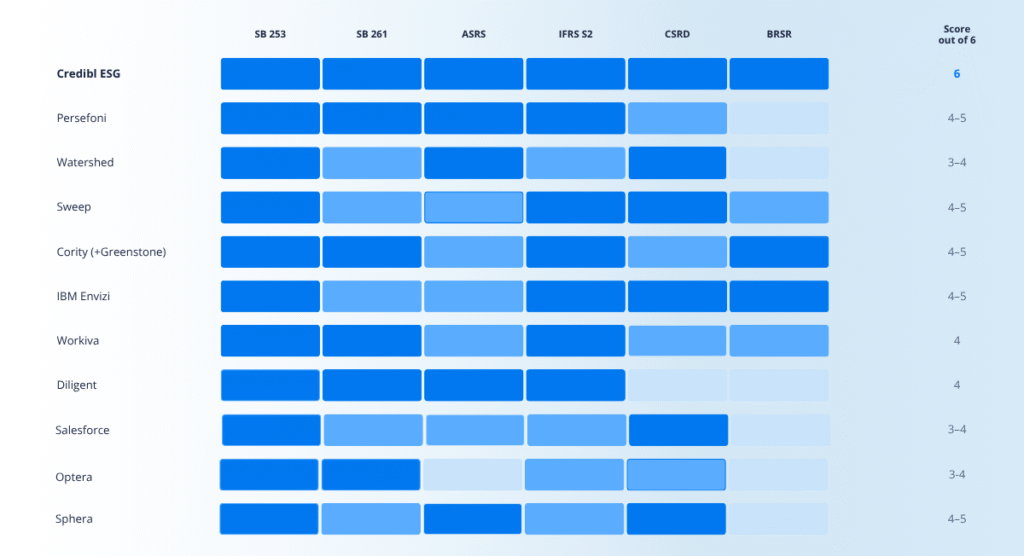
Feature lists tell you what a platform claims. The matrix below shows where those claims hold up across the capability dimensions that matter for California SB 253 and SB 261 compliance.
Most platforms handle basic emissions reporting adequately. The gap shows up in multi-framework mapping, where automated tracking of carbon emissions across SB 253, SB 261, CSRD, and IFRS S2 on a single dataset separates purpose-built climate disclosure software from single-framework tools that double your team’s workload every reporting cycle.
FRAMEWORK COVERAGE CODE:
Dark blue = Full · Light blue = Partial · Pale = Not covered. Credibl is the only platform with full coverage.
How to run your SB 253 software evaluation: A practical checklist
Most SB 253 software evaluations follow a standard enterprise procurement process — demos, RFPs, pricing. That works fine for CRM.
For climate disclosure software, it skips the questions that actually determine whether your platform holds up under a CARB assurance engagement.
Five steps that change that:
Step 1: Map your reporting entity structure
Which entities are in scope? Are subsidiaries reporting consolidated or separately? Getting your organisational boundary wrong before platform configuration is an expensive fix.
Step 2: Audit your existing emissions data honestly
What greenhouse gas emissions data do you actually have — utility invoices, ERP records, supplier questionnaires? Your Scope 3 data maturity determines which platform is right for you more than any feature list will.
Step 3: Shortlist for assurance readiness, not features
Ask every vendor to demonstrate per-data-point audit trail capability live in the platform — not in a slide deck. If they can’t show it, remove them.
Step 4: Bring finance, sustainability, and legal into one room
These three functions own different parts of your SB 253 programme. A platform that works for one and breaks for another creates friction in every reporting cycle.
Step 5: Confirm CARB output format and go-live date in writing
Roadmap items are not a compliance solution for a deadline under 90 days away. Get the confirmed implementation timeline before signing.
Why Credibl suits SB 253 and SB 261 compliance needs
Most platforms solve one problem well. Credibl is built for companies that need to solve several at once and can’t afford the operational drag of running parallel tools for each reporting obligation.
One data model, multiple outputs
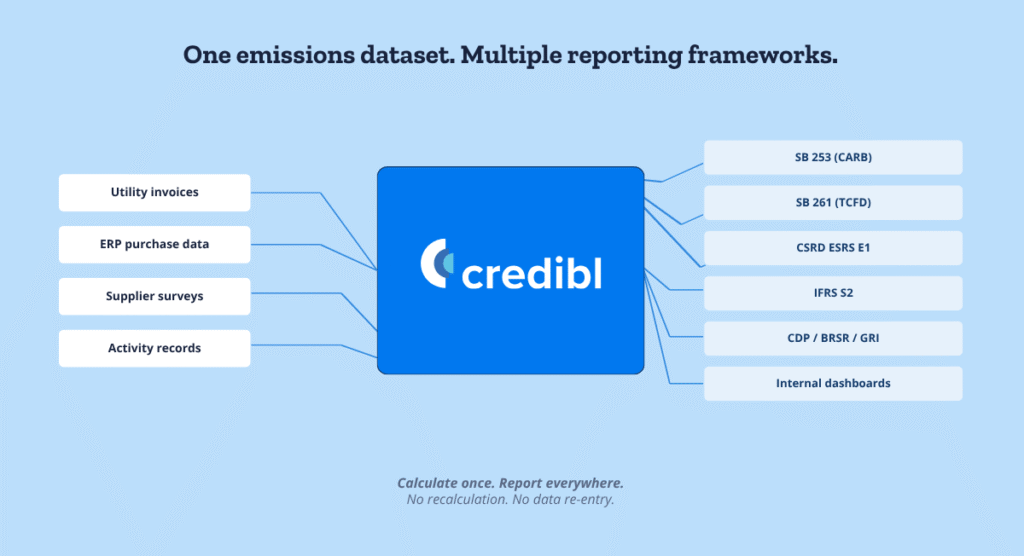
Credibl runs SB 253 emissions reporting and SB 261 climate risk disclosure as parallel workflows on a single dataset. Utility invoices, ERP purchase data, supplier surveys, and activity records feed one centralised climate data model — governed by the Greenhouse Gas Protocol — and produce structured outputs across every major reporting framework without recalculation.
That matters practically. The same underlying emissions data that satisfies your CARB submission also drives your TCFD-aligned SB 261 climate risk reporting, your CDP response, your IFRS S2 climate related financial disclosures, and your CSRD ESRS E1 filing. Finance teams track progress against climate commitments. Sustainability teams manage emissions reduction targets. Both functions pull from the same verified dataset.
Climate risk management built for SB 261
SB 261 requires more than a disclosure — it requires a structured climate risk assessment covering physical risks, transition risks, governance, and strategy.
Credibl’s climate risk management module supports scenario analysis aligned with TCFD’s recommended frameworks, letting teams model physical and transition risk exposure across different climate pathways and translate that into the financial impact language regulators and investors expect.
When SB 261 enforcement resumes after the Ninth Circuit ruling, companies with a functioning climate risk modeling capability — not a manually assembled Word document — will be in a materially different position than those starting from scratch. Credibl’s SB 261 module is designed to make that climate risk disclosure repeatable, not a one-off exercise rebuilt every reporting cycle.
Built-in assurance readiness
The audit processes that assurance providers run under ISSA 5000 and ISAE 3410 are not a mystery — they test traceability, methodology consistency, and documentation completeness.
Credibl’s per-data-point audit trail is built to pass those tests, not to pass a demo. Every number in your regulatory reporting links to its source document, emission factor version, and calculation log. When your auditor samples your Scope 2 purchased electricity figure, that trace takes seconds, not hours.
For companies preparing for the limited assurance requirement from 2027, and reasonable assurance from 2030, the question isn’t whether your data is accurate — it’s whether your platform can prove it.
Implementation: 8–12 weeks to auditor-ready
Mid-market implementations run 8–12 weeks from kickoff to first auditor-ready dataset. Enterprise programmes with multi-framework mapping run 10–14 weeks.
With the August 10 deadline now under 90 days away, that implementation window is the deciding factor. A platform you can’t go live on before the filing date is not a solution for this reporting cycle.
Before the deadline hits, here’s what teams like yours are still trying to figure out.
Frequently asked questions about SB 253 & 261 reporting software
What happens if we miss the August 10 deadline?
CARB can impose penalties of up to $500,000 per year for non-compliance with California’s climate disclosure laws. For good-faith first-year submissions, CARB has indicated it will exercise enforcement discretion. Companies that were not collecting emissions data as of December 2024 should submit a statement on company letterhead to CARB explaining non-submission. Silence is not treated as compliance.
Do we need third party assurance for the first filing?
No. Limited assurance is not required for the 2026 reporting cycle. It becomes mandatory from 2027 for Scope 1 and 2 greenhouse gas emissions under recognised standards including ISSA 5000 and ISAE 3410. Use this first year to build the audit trail and internal controls your assurance processes will depend on. Starting now is significantly cheaper than retrofitting before your first mandatory engagement.
Do we need separate software for SB 261?
No. Any platform with climate risk assessment and scenario analysis capability handles both california climate laws on the same dataset. Your SB 261 climate related financial disclosures draw directly from the same verified greenhouse gas emissions data as your SB 253 CARB submission. One data model eliminates reconciliation, version conflicts, and duplicate data management overhead across teams.
Our company is headquartered outside the US, do California’s climate disclosure regulations still apply?
Yes, if you have a US entity doing business in California with annual revenues above the applicable threshold. California SB 253 and SB 261 apply to business entities formed under US law, including US subsidiaries of non-US parent companies. Your global headquarters location is irrelevant. What matters is whether your US entity clears the revenue threshold and California nexus tests for the prior fiscal year.