

If your largest customer has just requested an EcoVadis rating, or your sustainability team is preparing to go through the process for the first time, you are far from alone. EcoVadis has become the dominant benchmark for supply chain sustainability performance, with procurement teams at global corporations using it to assess, compare, and qualify their suppliers.
This guide explains what EcoVadis is, how the rating system and scoring methodology work, what your results mean commercially, and practical steps to improve your score across each of the four assessment themes.
EcoVadis is a global provider of business sustainability ratings, covering more than 175,000 companies across 180 countries and 250 industries. It operates as a third-party assessment platform, evaluating companies on their environmental, social, and governance practices and producing a standardised scorecard that business partners, procurement teams, and buyers can access and compare.
The EcoVadis platform sits at the intersection of corporate social responsibility and commercial procurement. Unlike self-reported ESG disclosures or investor-facing ratings such as MSCI or Sustainalytics, EcoVadis is specifically designed for B2B supply chain contexts, where buyers need evidence-based, comparable data on the sustainability management of their suppliers.
EcoVadis methodology is aligned to internationally recognised frameworks including the UN Global Compact, GRI, and ISO 26000. This alignment gives the EcoVadis rating credibility not just in procurement contexts but in regulatory and investor ones too, as the same sustainability data can support multiple reporting requirements.
Companies typically receive an invitation to complete an EcoVadis assessment when a buyer has made it a condition of supplier qualification. Increasingly, however, organisations are also choosing to pursue the rating proactively, recognising that a strong score can open doors with new customers and provide a competitive edge in markets where sustainability credentials are a commercial requirement.
The EcoVadis rating evaluates the quality of a company’s sustainability management system, not simply its sustainability outcomes. This distinction matters: EcoVadis is looking at how well sustainability is embedded into the way the business operates, not at headline metrics alone.
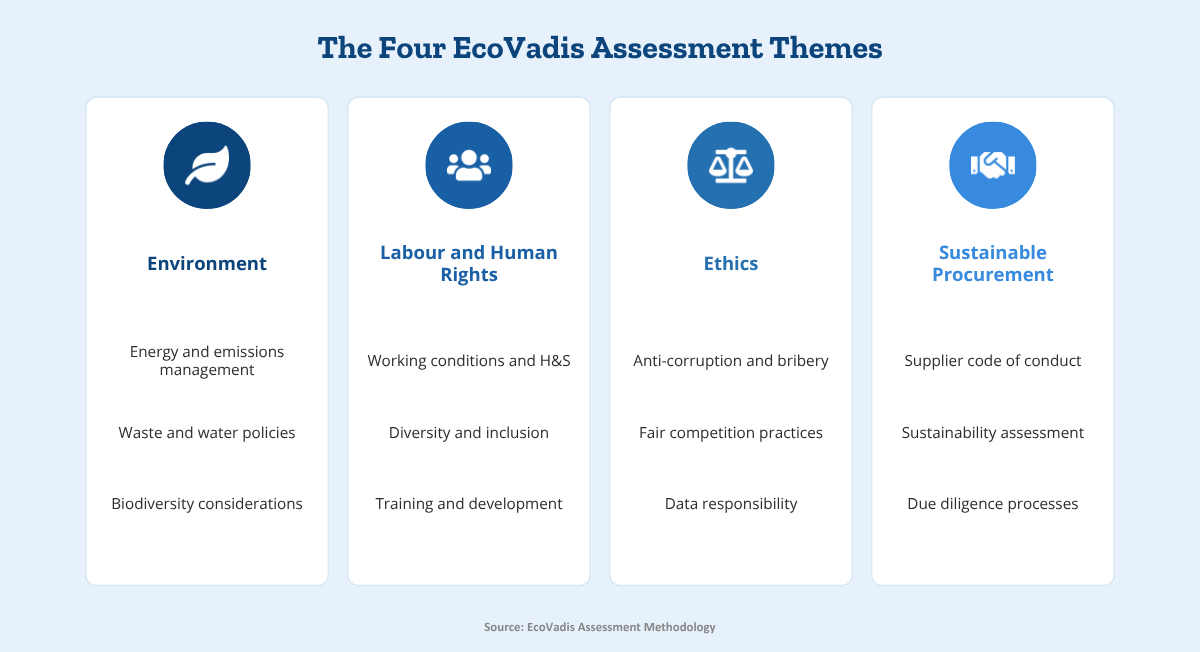
The assessment is structured around four key themes: Environment, Labour and Human Rights, Ethics, and Sustainable Procurement. These are evaluated using 21 sustainability criteria, with the weighting of each theme adjusted according to the company’s industry, company size, and geographic context.
Within each of the four key themes, EcoVadis applies a three-part methodology known as Policies, Actions, and Results (PAR). Policies account for approximately 25% of the score and cover documented commitments such as published environmental policies and codes of conduct. Actions carry the highest weight at around 40%, covering certifications, the measures a company has implemented, and the coverage of those measures across the organisation. Results account for approximately 35% and are assessed through sustainability reporting, sustainability metrics, and external monitoring via the 360° Watch.
The 360° Watch is an AI-powered monitoring function that continuously tracks external sources, including news media, NGO publications, and trade union communications, for information relevant to a company’s sustainability practices. Findings can influence both the overall score and medal eligibility.
Assessments run annually. Scores are valid for 12 months from the date of scorecard publication, and companies must submit a new questionnaire and updated supporting documents each year to maintain an active rating. Beginning the renewal process two to three months before expiry is advisable to avoid any gap in active status.
The EcoVadis scorecard presents an overall score from 0 to 100, alongside individual scores for each of the four main themes. As of January 2025, individual theme scores are displayed as unrounded figures rather than rounded values, providing more precise and detailed insights into where a company’s performance is strongest and where improvement is most needed.
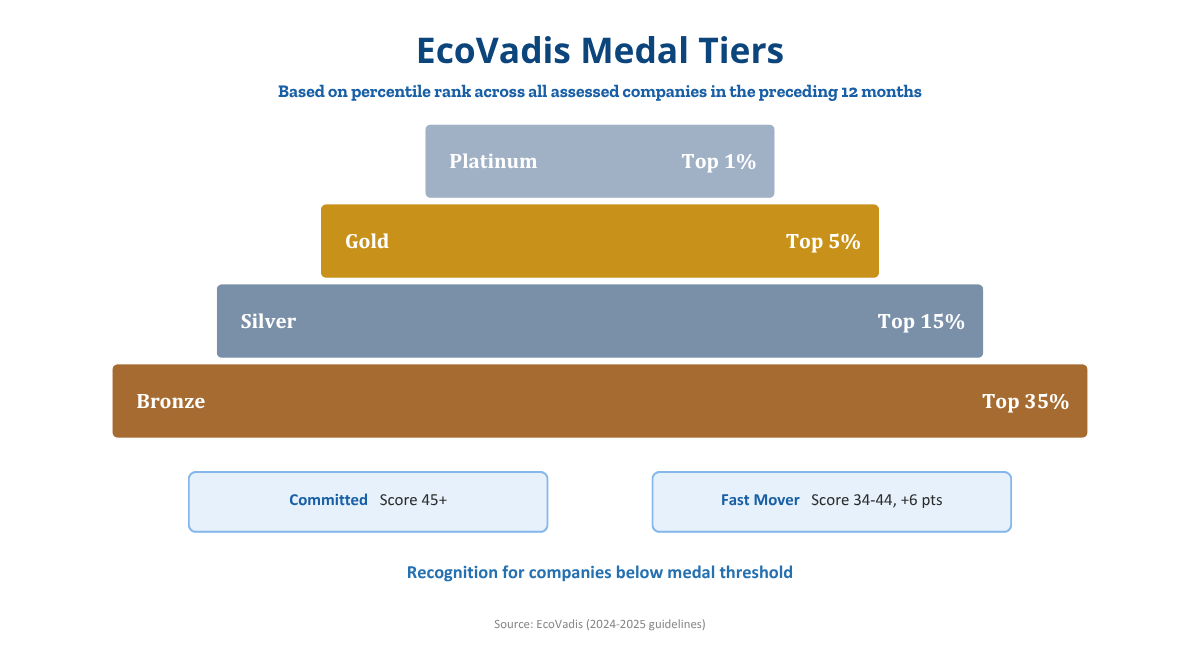
Since 2024, EcoVadis medals are awarded based on percentile rank rather than fixed score thresholds. This means a company’s performance is measured relative to all assessed companies in the EcoVadis database over the preceding 12 months, not against a static point target.
The four medal tiers are:
To be eligible for an EcoVadis medal, a company must achieve a minimum score of 30 in each of the four themes. Scoring below this threshold in any single area, regardless of the company’s overall score, removes medal eligibility entirely. This requirement reflects EcoVadis’s comprehensive approach: strong performance in one theme cannot offset an inadequate standard in another.
Two additional recognition levels are available for companies not yet at medal threshold. A Committed badge applies to companies scoring 45 or above, reflecting a foundational sustainability commitment. A Fast Mover badge recognises companies between 34 and 44 points that have improved by at least 6 points compared to their previous assessment, rewarding progress regardless of absolute level.
A strong EcoVadis score has become a commercial differentiator in many sectors. Large buyers frequently set minimum score thresholds, often 45 or above, as a condition of supplier approval. Companies that fall below these thresholds risk exclusion from tenders and supplier panels regardless of their price or quality position.
Beyond the minimum score, holding a Silver, Gold, or Platinum EcoVadis medal strengthens brand reputation among procurement teams and sustainability leads at major corporations. It signals a mature, documented sustainability management system and provides evidence of continuous improvement, both of which carry weight as supply chain due diligence obligations tighten under regulations such as the EU Corporate Sustainability Due Diligence Directive (CSDDD).
The EcoVadis platform also operates on a share-once model: one assessment, completed once, can be shared with the company’s full customer network. This reduces duplication significantly, freeing sustainability teams from responding to multiple individual buyer questionnaires and allowing the same documentation effort to serve multiple business partners simultaneously.
The EcoVadis questionnaire is tailored to each company based on its industry classification, company size, and country of operation. Not all 21 criteria are activated for every company: questions most relevant to your sector’s specific sustainability risks carry greater weight in the scoring, and criteria assessed as lower relevance for your industry may be excluded entirely.
Before beginning, map your existing sustainability policies, certifications, and management practices against the four key themes. This pre-assessment audit will surface gaps early, when they are still addressable. Pay particular attention to areas where policy exists informally but documentation is absent or scattered: the EcoVadis questionnaire rewards organised, accessible evidence over undocumented good practice.
Supporting documentation is central to the EcoVadis assessment process. Company declarations alone are not sufficient; each claim must be backed by verifiable evidence. Relevant documentation to gather across the four themes includes published environmental or sustainability policies, health and safety management records, diversity and inclusion data, anti-corruption codes of conduct, supplier codes of conduct or supplier assessment records, relevant third-party certifications such as ISO 14001 or ISO 45001, and any available sustainability reports.
Evidence should be current and directly relevant to the company’s operations. EcoVadis experts are experienced at distinguishing between documentation assembled for the assessment and documentation that reflects how the business actually operates. The former rarely scores well.
We’ve pulled the key documentation requirements across all four themes into a single checklist you can work through before your submission.
Improving an EcoVadis score requires a structured, theme-by-theme approach. Companies that attempt to address every area at once typically see limited progress. A focused corrective action plan, prioritised according to where the largest gaps exist between current practice and assessment requirements, is the most effective starting point.
The Environment theme covers energy consumption, GHG emissions, waste management, water use, and biodiversity. For most companies, the most direct route to improvement is publishing a clear environmental policy that includes measurable reduction targets, and disclosing carbon footprint data covering at least Scope 1 and Scope 2 emissions. Where Scope 3 data is available, including it strengthens the Results component of the score.
Third-party certifications such as ISO 14001 demonstrate that an environmental management system is formally embedded, which carries significant weight in the Actions section. Annual sustainability reporting, even a concise summary of energy consumption and emissions trends, signals transparency and continuous improvement to assessors.
The Labour and Human Rights theme covers working conditions, health and safety, diversity, training, and the rights of workers, including protections recognised by trade unions. Formal, documented HR policies are the baseline requirement. Beyond policies, assessors look for evidence of implementation: health and safety audit records, diversity data, training completion rates, and documented compliance with applicable labour law.
Companies operating in higher-risk industries or geographies face more detailed scrutiny in this area. Third-party audits of working conditions, or participation in recognised industry programmes, strengthen the Actions section considerably.
The Ethics theme covers anti-corruption and bribery, anti-competitive practices, whistleblowing, data responsibility, and the management of ethics standards with other third-party organisations. A published code of conduct addressing corruption and fair competition is the minimum expected. Beyond this, assessors look for formal whistleblowing channels, documented anti-corruption training, and evidence that ethics standards are actively communicated to employees and applied consistently across all jurisdictions.
Sustainable Procurement is consistently the lowest-scoring area across the EcoVadis database, which makes it one of the highest-impact areas for a corrective action plan. The theme evaluates whether and how a company integrates sustainability into its own supplier selection, assessment, and management processes.
Practical steps include publishing a supplier code of conduct, implementing a formal supplier engagement and assessment process aligned with sustainability criteria, and establishing supply chain due diligence procedures in line with applicable regulations. These sustainable procurement pillars signal to assessors that sustainability management extends beyond the company’s own operations into its supply chain, which is increasingly what large corporate buyers require.
EcoVadis vs CDP
CDP focuses primarily on environmental disclosure, covering climate change, water security, and deforestation. Its primary audience is investors and financial markets. EcoVadis covers a broader scope, including Labour and Human Rights, Ethics, and Sustainable Procurement, and its primary context is B2B procurement. The two are not substitutable: many companies are asked to complete both, for different purposes and different audiences.
EcoVadis vs MSCI and Sustainalytics
MSCI ESG Ratings and Sustainalytics are investor-facing tools designed for publicly listed companies, typically assessed using publicly available data. EcoVadis applies equally to private and unlisted companies of any size and is based on submitted documentation rather than public disclosures. For suppliers in global value chains, EcoVadis is far more commonly requested.
When EcoVadis is the right choice
EcoVadis is most relevant when sustainability performance needs to be demonstrated to B2B buyers, when a company wants a single standardised assessment it can share across its customer network, or when procurement teams want an EcoVadis benchmark against which to evaluate and improve supply chain sustainability. It is particularly well suited to companies that face multiple overlapping buyer questionnaires and want to streamline the process without compromising the quality of their sustainability reporting.
One of the distinguishing features of the EcoVadis assessment process is the role of human expertise. Every scorecard is reviewed by more than 500 in-house sustainability analysts who evaluate submitted evidence against the company’s specific context before any score is published.
This means the quality of documentation submitted matters as much as the policies declared. Generic templates, vague statements, and certifications no longer current are unlikely to perform well under expert analysis. Specific, verifiable evidence aligned to actual business operations is what assessors reward.
For companies approaching their first assessment or targeting a higher medal tier, mapping evidence systematically to the seven management indicators within the PAR framework, covering Policies, Endorsements, Measures, Certifications, Coverage, Reporting, and 360° Watch, produces the most actionable insights and the clearest improvement pathway.
This is where the infrastructure matters. Collecting ESG data across multiple themes, keeping documentation organised and accessible, and maintaining records in a state ready for submission year-round is significantly more manageable when it is built into a company’s sustainability management workflow rather than assembled under time pressure at renewal.
Credibl helps sustainability and procurement teams prepare for EcoVadis and other sustainability ratings by centralising ESG data collection, organising documentation by theme, and keeping records assessment-ready throughout the year. See how it works →
A score of 45 or above is the threshold many large buyers set for supplier qualification, so this is a practical starting benchmark for companies going through the process for the first time. A Bronze medal, awarded to companies in the top 35% of all assessed companies, represents a meaningful level of recognition. Gold (top 5%) and Platinum (top 1%) signal advanced sustainability management and are increasingly sought after in competitive supplier panels. The average score across the EcoVadis network has risen year on year as the database grows and companies invest more in sustainability management.
The time required depends on two things: how long it takes the company to complete the questionnaire and gather supporting documentation, and how long EcoVadis analysts take to review and publish the scorecard after submission. Companies that have their documentation organised in advance can complete the questionnaire in a matter of days. The analyst review period after submission typically takes several weeks. Building in enough time before a buyer deadline, ideally starting the process two to three months ahead, reduces pressure considerably.
EcoVadis charges suppliers a fee to complete the assessment. The fee is based on company size and is set by EcoVadis directly. Buyers, the companies requesting the rating from their suppliers, pay separately for access to the platform and supplier scorecards. For current pricing, check the EcoVadis website or contact them directly, as rates are updated periodically.
Yes. EcoVadis operates on a share-once model, which means a company completes one assessment and can share the resulting scorecard with multiple buyers and business partners through the platform. This is one of the practical advantages of EcoVadis over responding to individual buyer questionnaires: the same documentation effort serves the entire customer network.
EcoVadis scores are valid for 12 months from the date of scorecard publication. If a company does not renew before expiry, the medal becomes inactive and can no longer be used in communications or marketing. The scorecard is marked as expired on the EcoVadis platform, and buyers viewing it will see it as outdated, which can affect supplier credibility and eligibility for procurement processes. Renewal requires submitting a new questionnaire and updated documentation; it is not automatic.
CDP focuses primarily on environmental disclosure, covering climate change, water security, and deforestation, and its primary audience is investors and financial markets. EcoVadis covers a broader scope that includes Labour and Human Rights, Ethics, and Sustainable Procurement alongside the environment, and its primary context is B2B procurement. The two serve different purposes and different audiences. Many companies are asked to complete both, typically CDP for investor and reporting obligations and EcoVadis for supplier qualification.