

Finance stopped trusting spreadsheets decades ago. ESG is making the same move.
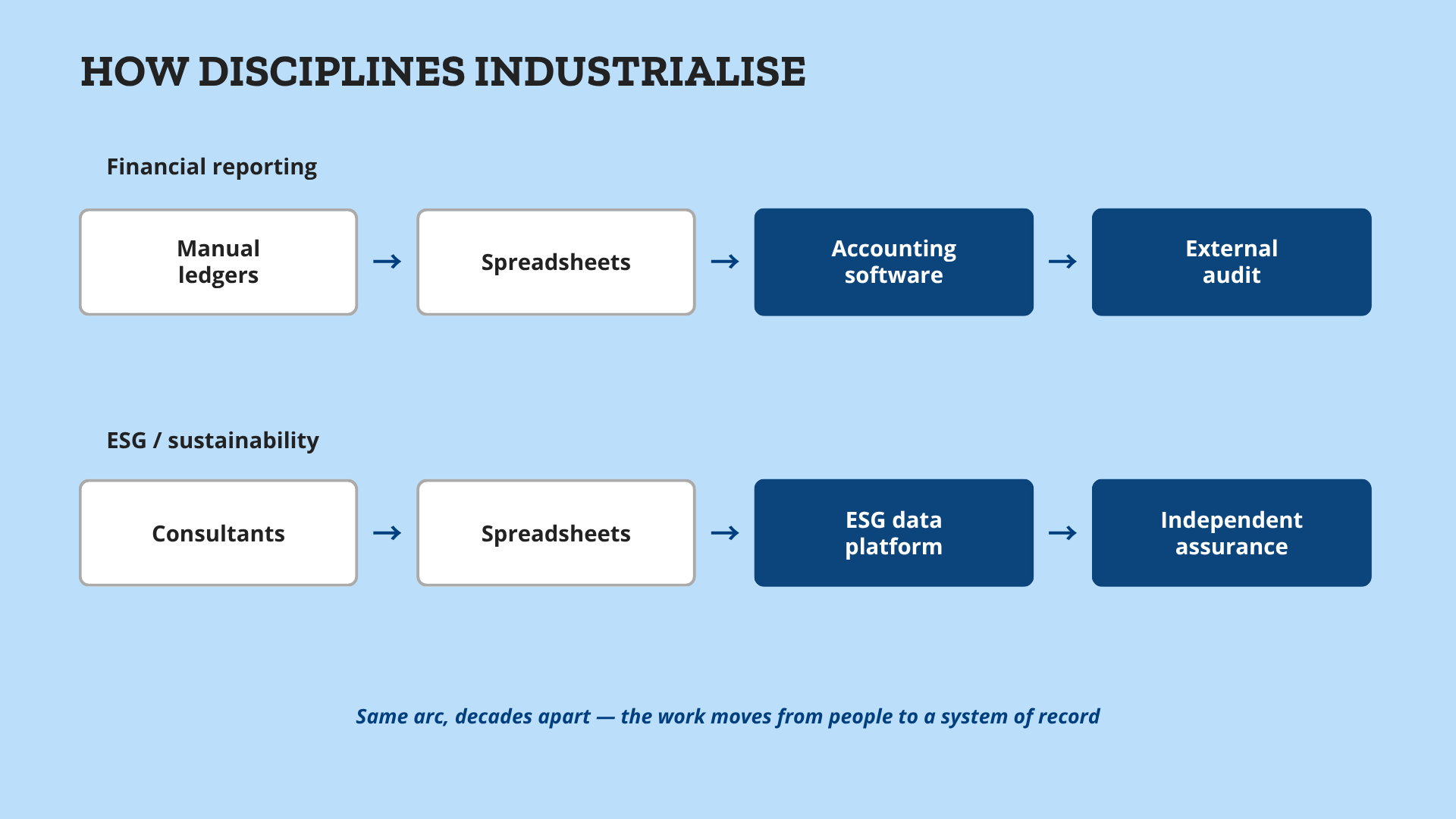
Every emerging discipline that becomes business-critical follows the same arc. First, it is a craft, practised by a handful of experts who charge by the hour. Then it becomes a process — run on software, with the experts moving up the value chain to do the work software cannot.
Financial reporting went through it. So did tax, payroll, and legal review. ESG is now squarely in the middle of the same transition, and the companies that recognise it early will spend far less getting to the other side.
The argument here is not that consultants failed. It is the opposite: Consulting did exactly what it was supposed to do in the early innings, and the discipline has now outgrown the model.
How Finance Made This Exact Journey
Rewind a few decades. Bookkeeping was a manual craft. Companies relied on accountants to hand-rule ledgers, reconcile entries by hand, and assemble the annual accounts. The expertise lived in people’s heads, and the work was outstanding, each time.
Then two forces reshaped it. Reporting became mandatory and standardised — you could no longer describe your finances however you liked; you had to follow rules, file on a schedule, and submit to an external audit.
And the sheer volume of transactions exploded. Spreadsheets helped for a while, then buckled under their own weight. The answer was never “hire more accountants.” It was the ledger as software: ERP and accounting systems, a single source of financial truth that updated continuously and produced audit-ready output on demand.
Crucially, the accountants did not disappear. They moved. The grunt work of recording transactions went to the system; the humans went upstream — to strategy, controls, and the judgement calls software cannot make.
Auditing, meanwhile, grew into its own assurance industry built on top of the system of record.
ESG Is Replaying The Tape
ESG today looks almost exactly like finance did before the platforms arrived.
The discipline is young, the rules were vague, and the early heavy lifting fell to consultants. That was the right model for the era. When nobody knew which frameworks would win, what “material” really meant, or how to even draw a Scope 3 boundary, you wanted a smart human improvising in a spreadsheet — not a rigid system locking in the wrong assumptions.
But the conditions that made consulting the right answer have now flipped, one by one:
- Reporting went mandatory. CSRD, BRSR, ISSB and a wave of climate-disclosure rules mean ESG is no longer a glossy brochure. It is a regulated filing with deadlines and legal weight.
- It became auditable. Limited and reasonable assurance requirements mean your numbers must survive an outside reviewer. A bespoke spreadsheet rebuilt from scratch each year is exactly what an auditor distrusts.
- It became continuous. Emissions data is no longer an annual snapshot. It flows in monthly from utility bills, ERP systems, suppliers, and travel platforms. Humans cannot keep that current by hand.
- It became multi-framework. The same underlying inventory has to feed five different disclosures. Re-deriving it five times is how inconsistencies creep in — and inconsistency is precisely what gets flagged.
The annual-engagement model was not built for any of this. It is project-shaped work being asked to do product-shaped jobs: a system of record, version control, audit trails, continuous data ingestion, and one-click output across frameworks.
Those are not consulting deliverables. They are software features.
Two Different Shapes of the Same Work
| Project-shaped (consulting) | Product-shaped (platform) |
| Annual project — rebuilt each cycle | A living system that updates continuously |
| Output lives in someone’s spreadsheet | Single source of truth, versioned and traceable |
| “Trust us, we calculated it” | Every number traces to its source document |
| Re-derived separately per framework | One inventory feeds every disclosure |
| Knowledge walks out with the consultant | Knowledge stays in the platform |
What “Product” Actually Changes
When ESG moves from engagement to platform, three things happen at once.
The data becomes a system of record — a single, living inventory everyone works from, with the lineage of every number traceable back to its source document. That is the difference between “trust us, we calculated it” and “here is exactly where this figure came from,” which is precisely what assurance demands.
The work becomes continuous instead of seasonal. Instead of a frantic six-week scramble before the report is due, data is captured as it is generated, and the report is essentially always ready.
And the humans move upstream. Just as accountants became strategic advisors, ESG experts do not vanish — they stop spending expensive hours wrangling spreadsheets and start doing what only they can: shaping decarbonisation strategy, interpreting ambiguous regulation, and advising the board.
AI accelerates this further, handling the extraction, mapping, and anomaly-detection that used to eat analyst-weeks.
Where The Consultants Go Next
It is worth being clear that this is not a story about software replacing people. In finance, the rise of the system of record did not shrink the profession — it elevated it. The work that survived automation was the high-judgement work, and it commanded a premium.
The same will be true in ESG. Strategy, materiality, transition planning, scenario analysis, and assurance are growing, not shrinking. What is disappearing is the part of the job that was always really data plumbing.
The Takeaway
Consulting got ESG off the ground. It built the frameworks, grew the expertise, and proved the discipline mattered. But ESG has outgrown the model — you cannot run a regulated, audited, always-on function on an annual engagement, any more than a modern finance team could run on hand-ruled ledgers.
ESG is following finance’s path, just compressed into a fraction of the time. The system of record is arriving. The consultants are moving upstream. And the companies that adopt the platform layer now will look back on the spreadsheet years the way finance teams look back on the abacus.
This piece was shaped in partnership with Deepak Patel, Product Manager at Credibl, whose customer and product perspective gave it the depth it needed.
[NOTE: The ideas and perspective are entirely his. AI was used to refine the prose.]