

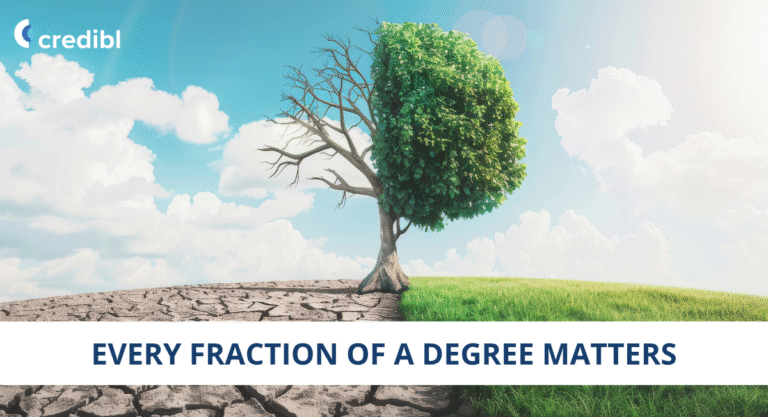
Is it too late to stop climate change?”
If you have opened LinkedIn this week, chances are you have seen someone ask exactly that, usually right after a headline about record heat or another tipping point warning.
It is a fair question, and it deserves a straight answer, absolutely.
The earth is already warmer. Some effects of climate change are locked in: Extreme weather scenes, sea level rise, and disruption that will continue for decades regardless of what the world does next. That is the climate crisis we are living in.
So to say, we are not too late to avoid the worst of it. If we act now, the most severe climate impacts are still avoidable, and the decisions businesses make in the next five to ten years will shape the version of the future we get to breathe in.
This is not a pep talk.
Climate change: What the science tells us
The Intergovernmental Panel on Climate Change (IPCC) Sixth Assessment cycle — Working Groups I, II and III (2021 to 2022) and the Synthesis Report (2023) — is the most comprehensive synthesis of climate science ever produced.
Its findings are unambiguous: human-caused climate change is already affecting every region on earth, and the pace of change is accelerating.
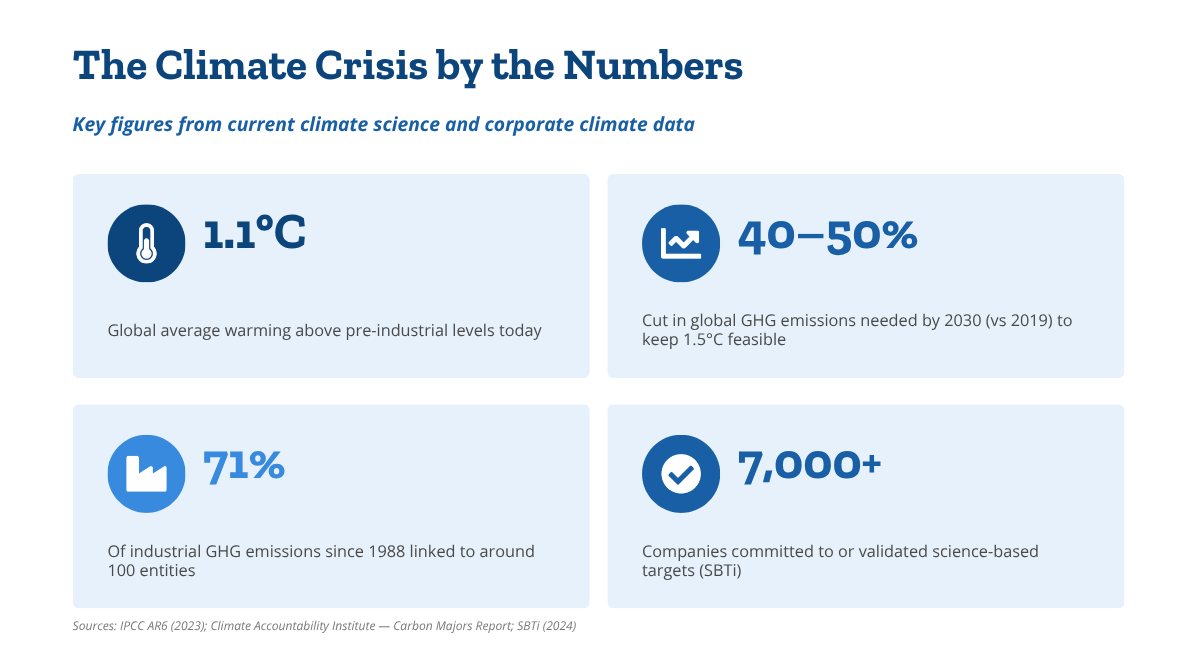
Global surface temperatures have risen by roughly 1.1°C above pre-industrial levels (IPCC AR6 Synthesis Report, 2023). Many near-term climate projections indicate a greater than 50% chance of a temporary exceedance of 1.5°C in the early 2030s under current policies and trajectories (IPCC AR6 SSP scenarios).
The IPCC AR6 Working Group III report indicates that many 1.5°C-consistent scenario ensembles require global greenhouse gas emissions to fall by roughly 40 to 50% by 2030 versus 2019 levels to keep the 1.5°C pathway feasible (IPCC WGIII, 2022), with global CO2 reaching net zero by approximately 2050.
Current national commitments fall significantly short of that trajectory.
About the 1.5°C pathway
Technically, the 1.5°C pathway is still achievable. The IPCC is explicit that the technologies and knowledge we need to halve emissions this decade already exist.
The gap is not one of capability. It is one of deployment speed and will.
Some climate scientists now frame 1.5°C as likely to be temporarily exceeded before mid-century. The more actionable goal becomes limiting overshoot and returning below 1.5°C later in the century — through carbon capture and other carbon dioxide removal methods — while staying well below 2°C overall.
That reframing matters: it shifts the question from whether a single threshold has been crossed to how much additional warming we are willing to lock in, and what that costs in human and economic terms.
The window is narrowing. But it is not yet closed.
Are the climate tipping points already triggered?
A climate tipping point is a threshold in the earth’s climate system beyond which change becomes self-reinforcing and largely irreversible — even if emissions stop entirely. The most consequential climate tipping points include the destabilisation of the Greenland and West Antarctic Ice Sheets, loss of Arctic summer sea ice, dieback of the Amazon rainforest, collapse of the Atlantic Meridional Overturning Circulation (AMOC), and large-scale permafrost thaw.
Permafrost thaw is one of the clearest examples of self-reinforcing feedback loops: as frozen ground melts, it releases stored carbon dioxide into the atmosphere and drives further warming, which causes more permafrost to thaw.
The earth’s carbon sinks — forests, wetlands, and oceans that draw carbon dioxide from the atmosphere and store it — also become less effective as temperatures rise, reducing the planet’s natural capacity to buffer its own warming.
A landmark 2022 study published in Science by Armstrong McKay et al. identified 16 major tipping elements and found that five could be triggered at temperatures already within reach — around 1.5°C to 2°C of warming.
The concern is not just individual tipping points but cascading interactions: crossing one can increase the likelihood of triggering another.
Coral reefs
Coral reefs are one of the clearest early benchmarks of where we already stand.
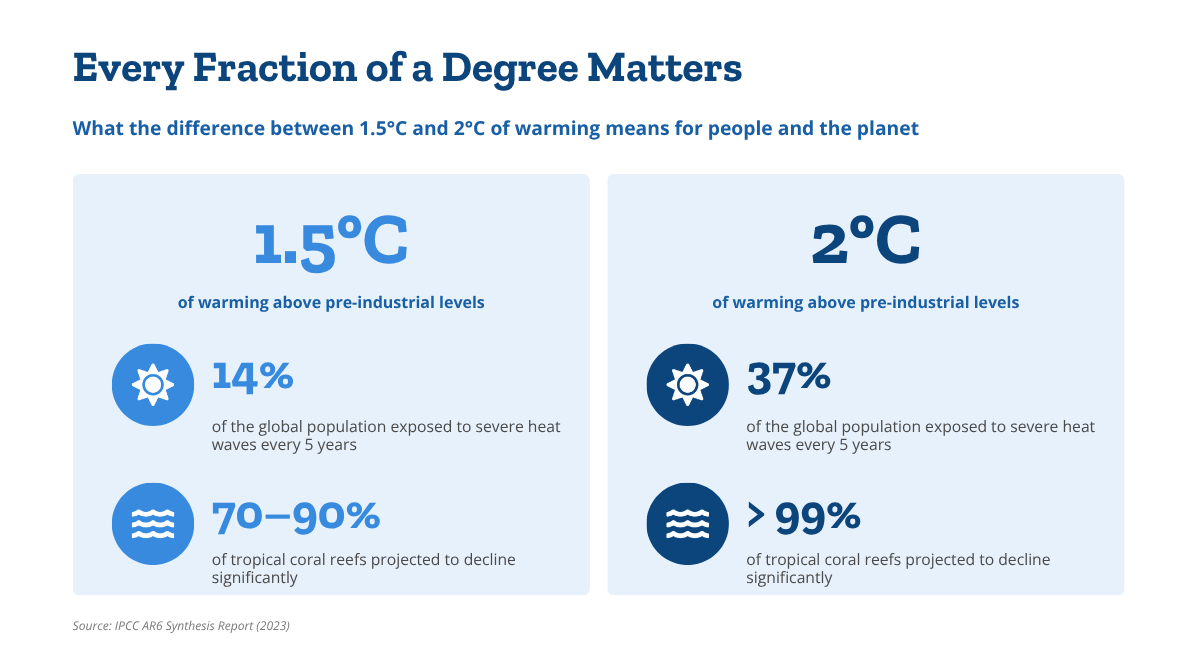
At 1.5°C of warming, 70 to 90% of tropical coral reefs are projected to decline significantly. At 2°C, that rises above 99%. These reefs support approximately a quarter of all marine species and provide food and coastal protection for hundreds of millions of people worldwide.
The science is precise about what is at stake — and equally precise that the difference between 1.5°C and 2°C of global warming is not marginal.
Climate change and the cost of inaction
Are the worst outcomes still avoidable?
Yes. The effects of climate change intensify with every fraction of a degree — but that also means every fraction of a degree avoided delivers real-world benefits.
At 1.5°C, approximately 14% of the global population is exposed to severe heat waves every five years. At 2°C, that figure rises to 37% — hundreds of millions more people facing dangerous and potentially lethal heat events.
The number of species at high risk of losing more than half their geographic range more than doubles between the two thresholds.
There are, in other words, no binary outcomes here. “Too late” implies a point beyond which nothing matters. That is not how global warming works.
Every tonne of carbon dioxide and other greenhouse gases not released into the atmosphere is a real-world reduction in harm.
The economics of acting versus waiting
The relevant comparison for any business leader is not whether perfect climate outcomes are still achievable. It is: what does inaction actually cost?
Major economic analyses — including the Stern Review (2006), IPCC working group assessments, and OECD modelling — consistently find that the financial cost of unmitigated climate change across this century is several times greater than the investment needed for the transition, though exact magnitudes depend on discount rates and scenario assumptions.
Emissions reductions are expensive. But inaction is more expensive, and the costs compound the longer action is delayed.
There is also the question of who bears that cost. The effects of climate change fall disproportionately on the communities and economies least equipped to absorb them — coastal populations facing sea level rise, agricultural communities disrupted by changing rainfall, and regions already at the edge of survivable heat.
Policy changes that come too late lock in those outcomes for us and for future generations. Business decisions made now do not.
Fossil fuels and the scale of corporate emissions
The fossil fuel industry’s role in the climate crisis
The Carbon Majors Report (Climate Accountability Institute) attributed approximately 71% of industrial greenhouse gas emissions since 1988 to around 100 entities, including fossil fuel producers and cement manufacturers.
Across major inventories, energy (including electricity and heat) and industry together account for a majority of annual global emissions — though precise sector shares vary by dataset and year (IPCC AR6; IEA 2022). Fossil fuels remain the dominant driver of carbon emissions and of the climate crisis the world is now managing.
That is not only a story about the fossil fuel industry. It is a story about every company and system that depends on fossil fuels: manufacturing, transport, agriculture, construction, and finance.
Corporate activity sits at the centre of this problem — which means corporate climate action is not incidental to solving it. It is structurally necessary.
The case for science-based targets
Science-based targets are emissions reduction commitments validated against what climate science requires to limit warming to 1.5°C. The Science Based Targets initiative (SBTi) provides the most widely recognised framework for corporate target-setting on climate change and is now referenced in regulatory guidance across the EU, UK, and beyond.
As of 2024, over 7,000 companies globally had committed to or validated science-based targets (SBTi) — a figure that has continued to grow through 2025 and into 2026.
Climate goals without a validated, science-based pathway are increasingly viewed as insufficient by investors, regulators, and civil society. The way to separate credible commitments from aspirational statements is external validation against what the science actually requires.
Companies already leading on climate action
Across sectors, there are companies demonstrating that deep decarbonisation is compatible with commercial performance.
Steel producers are piloting green hydrogen routes to eliminate process emissions. Consumer goods companies are redesigning procurement to remove deforestation from supply chains. Financial institutions are aligning portfolios with net zero trajectories through financed emissions accounting.
The common factor is not sector or size — it is measurement quality, target credibility, and systematic integration of climate change solutions into core business operations.
Climate solutions your company can act on now
Measure your carbon footprint: Scope 1, 2, and 3
You cannot manage what you do not measure.
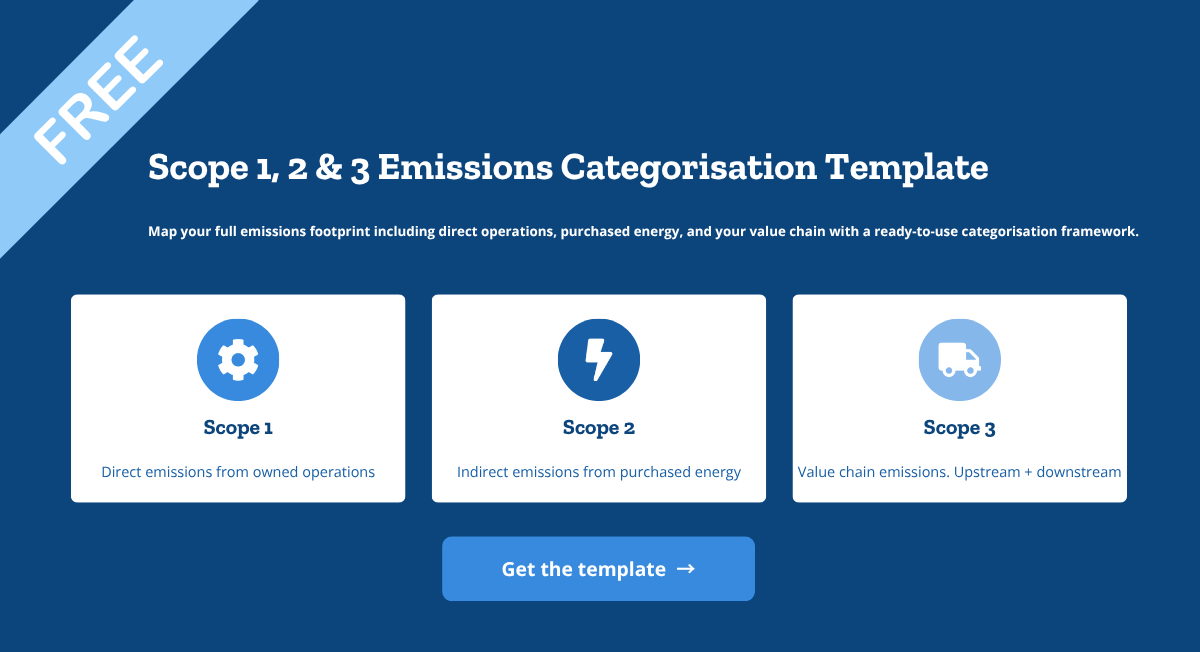
The most fundamental of all climate solutions is an accurate greenhouse gas inventory covering direct emissions from owned operations (Scope 1), indirect emissions from purchased energy (Scope 2), and value chain emissions from suppliers, products, and logistics (Scope 3) — as defined by the GHG Protocol Corporate Standard.
Scope 3 is where most companies discover the true scale of their footprint. For many businesses, value chain emissions account for more than 70% of total carbon impact — meaning operational efficiencies alone are not a way to reach net zero.
Getting Scope 3 right is one of the most important and most complex things a company can do to act on climate change, and it is where the most significant reduction opportunities typically sit.
Carbon dioxide and carbon capture
Residual emissions — those that cannot be eliminated through operational changes — need to be addressed by drawing carbon dioxide back from the atmosphere and storing it.
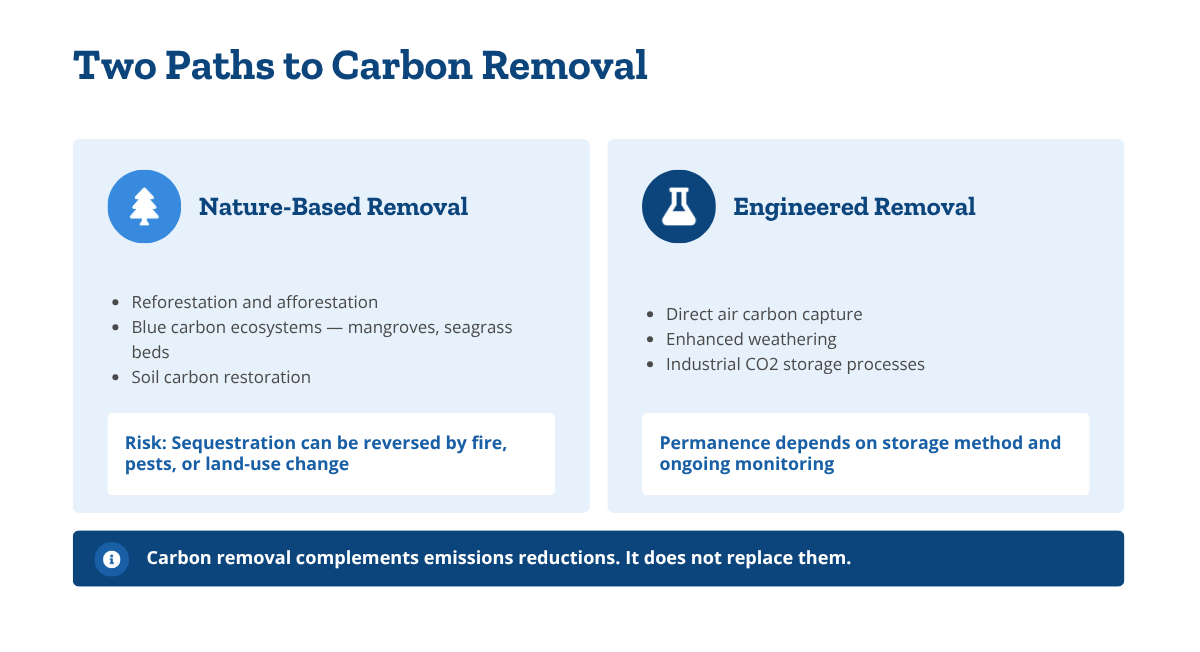
There are two main categories of climate solutions here. Nature-based approaches use carbon sinks such as reforestation, blue carbon ecosystems (mangroves, seagrass beds), and soil carbon restoration to sequester carbon dioxide from the atmosphere — though these face risks of reversal through fire, pests, and land-use change. Engineered solutions — including direct air carbon capture and enhanced weathering — remove CO2 from the atmosphere and other greenhouse gas sources through industrial processes, with permanence that depends on storage method and monitoring.
Carbon capture is not a way to avoid emissions reductions: it complements them, addressing residual carbon emissions that remain after all practical reductions have been made.
The quality of underlying credits matters. The Integrity Council for the Voluntary Carbon Market (ICVCM) has developed Core Carbon Principles and an Assurance Framework for voluntary carbon market standards — though multiple certification schemes exist and standards continue to evolve. Companies investing in low-quality offsets remain increasingly exposed to scrutiny.
Set credible net zero targets
A net zero emissions commitment without a science-based pathway is a reputational and regulatory risk.
Corporate net zero pledges typically mean deep cuts to near-zero emissions within a company’s boundary, with remaining residual emissions neutralised through high-quality removals — not offset purchasing as a substitute for reduction. Credible net zero requires near-term targets, coverage of all material scopes, and use of carbon removals only for residual emissions.
The SBTi Corporate Net Zero Standard can help companies set targets that cover all material emission sources, include near-term 2030 milestones, and are validated against what science requires. That external validation is what turns a pledge into a plan.
Engage your supply chain
For most companies, the largest source of emissions sits upstream and downstream in the supply chain. Meaningful progress on climate goals requires suppliers to provide emissions data, set their own reduction targets, and in some cases transition to lower-carbon production methods.
Platforms designed to help automate supplier outreach and consolidate carbon management workflows make this operationally feasible at the scale most businesses require.
Report transparently under CSRD and the GHG Protocol
Credibility depends on disclosure. Reporting under recognised frameworks — the GHG Protocol, TCFD, and mandatory regimes including the EU’s Corporate Sustainability Reporting Directive (CSRD) — provides external accountability and enables meaningful comparison across portfolios.
For companies operating in or selling into the EU, CSRD mandates disclosures on climate strategy, transition plans, and emissions performance. For companies with US operations, California’s SB 253 (2023) requires climate disclosures including Scope 1, 2, and certain Scope 3 emissions from large entities doing business in California — confirm current thresholds and compliance timelines with California Air Resources Board guidance.
Preparing early builds the infrastructure that will be required regardless of when enforcement arrives.
Climate action: The business case for acting now
Regulatory inevitability
The direction of travel on climate regulation is unambiguous. The EU’s CSRD and Corporate Sustainability Due Diligence Directive (CSDDD), expanding carbon pricing mechanisms, and mandatory climate disclosure requirements in the UK, Australia, and beyond all point the same way.
ESG performance measurement and reporting will be a compliance requirement for most significant businesses within this decade.
Carbon pricing and disclosure requirements are expanding across the EU, UK, and other jurisdictions, making the implicit cost of emissions increasingly explicit. Companies that have already measured, reduced, and disclosed their carbon emissions are better placed to absorb this shift.
Those that have not are accumulating regulatory risk.
Investor pressure and the cost of capital
ESG ratings, green finance instruments, and sustainability-linked debt are increasingly used to price climate risk and ambition.
Institutional investors managing multi-trillion dollar portfolios now treat emissions data, target quality, and credibility as material factors in investment decisions.
Companies with externally validated climate commitments face a lower cost of capital and broader access to green finance than those without. This is not a peripheral concern — it is a financial risk management issue, and one that becomes more acute as disclosure requirements make climate performance visible and comparable across industries.
First-mover advantage on climate
Businesses that act early on climate tend to develop operational efficiencies, supply chain resilience, and customer propositions that later movers cannot replicate at speed.
The companies best positioned for the next decade are those already embedding emissions measurement into their operating model — not those building the capability when mandates arrive. Early movers shape the standard. Late movers comply with it.
The answer.
Is it too late to stop climate change entirely? The warming already in the system will continue for years regardless. Some disruption is unavoidable.
But the question that matters for anyone making decisions today is different: can the worst outcomes still be avoided? Yes. Do business decisions in the next five to ten years determine which trajectory the world is on? Yes.
If we act now, we limit the damage. If we delay, we lock in more of it.
Every tonne of carbon dioxide not released into the atmosphere prevents harm that would otherwise be irreversible. Every fraction of a degree of global warming avoided matters to hundreds of millions of people whose lives will be shaped by what the climate looks like in 2050.
The science is not a case for despair. It is the most coherent case for climate solutions and action that exists.
Frequently asked questions
Is 1.5°C still achievable?
Technically, yes — but only with immediate, large-scale emissions reductions across all sectors. The IPCC is clear that the technologies required already exist. The challenge is deployment at speed and scale. Many scientists now consider 1.5°C likely to be temporarily exceeded before mid-century, making limiting overshoot and returning below 1.5°C through carbon removal the more actionable near-term goal.
What is the difference between net zero and carbon neutrality?
Carbon neutrality typically means offsetting emissions with carbon credits to achieve a net balance, often without deep cuts to actual emissions. Net zero, as defined by the SBTi Corporate Net Zero Standard and IPCC methodology, requires reducing emissions as close to zero as possible across all scopes, with any remaining residual emissions addressed only through high-quality, permanent carbon removal — not offsetting as a substitute for reduction.
What are Scope 1, 2, and 3 emissions?
Scope 1 covers direct emissions from sources a company owns or controls — fuel combustion, company vehicles, on-site processes. Scope 2 covers indirect emissions from purchased electricity, heat, or steam. Scope 3 covers all other indirect emissions across the value chain: purchased goods and services, business travel, employee commuting, product use, and end-of-life disposal. For most companies, Scope 3 represents the largest share of total emissions.
What is CSRD?
The Corporate Sustainability Reporting Directive (CSRD) is an EU regulation requiring large companies and listed SMEs to disclose detailed information on their sustainability strategy, climate transition plans, and emissions performance under the European Sustainability Reporting Standards (ESRS). It replaces the earlier Non-Financial Reporting Directive (NFRD) and significantly expands the scope of who must report, what must be disclosed, and the level of external assurance required.
Turn climate urgency into a concrete plan. Credibl gives your team the tools to measure, manage, and report emissions credibly across Scope 1, 2, and 3. See how it works →