

Carbon accounting is the practice of measuring, tracking, and reporting an organization’s greenhouse gas emissions. Think of it as a financial audit, but instead of dollars and cents, you’re tallying up the carbon dioxide, methane, and other greenhouse gases your operations generate. The result is a clear, quantifiable picture of your business’s carbon footprint, expressed in a universal unit called carbon dioxide equivalent (CO₂e).
Carbon accounting quantifies greenhouse gas emissions from organizations across three dimensions. It covers direct emissions from sources you own (like company vehicles or onsite generators), indirect emissions from the energy you purchase, and the much broader category of value chain emissions from everything your business touches upstream and downstream. Together, these three scopes give you a complete view of how much greenhouse gas your business puts into the atmosphere.
So why is carbon accounting important right now? Carbon accounting is becoming increasingly important as climate disclosure requirements expand across jurisdictions. The EU’s Corporate Sustainability Reporting Directive (CSRD) requires emissions tracking for over 10,000 companies, with the first wave of reports already published in 2025. California’s SB 253 mandates emissions reporting starting in 2026 for large businesses, with Scope 3 following in 2027. Singapore’s climate-related disclosure roadmap requires all SGX-listed companies to report Scope 1 and 2 from FY 2025, with the largest firms adding Scope 3 from FY 2026. Carbon accounting supports compliance with evolving climate regulations and aligns corporate actions with international climate goals like the Paris Agreement.
Credibl carbon accounting also unlocks practical advantages. It supports net zero emissions strategies, strengthens risk management, and increasingly determines access to finance, including green and sustainability-linked loans. For consumer-facing carbon accounting platforms like Credibl, understanding and enabling carbon measurement is becoming part of responsible financial intermediation.
Carbon Accounting Basics: Key Concepts You Need to Know
A greenhouse gas is any gas that traps heat in Earth’s atmosphere, contributing to global warming. The main gases tracked under carbon accounting include carbon dioxide (CO₂), methane (CH₄), nitrous oxide (N₂O), hydrofluorocarbons (HFCs), perfluorocarbons (PFCs), sulfur hexafluoride (SF₆), and nitrogen trifluoride (NF₃). Each has a different warming impact, which is why carbon accounting doesn’t just track CO₂ alone.
Your organization’s carbon footprint is the total amount of GHG emissions caused by its activities. This concept applies at multiple levels: an entire company, a single product, or even an individual employee’s commute. The broader the boundary you draw, the more complete the picture.
To compare different gases on equal footing, scientists use a metric called global warming potential (GWP). Methane, for example, has a GWP of approximately 28 over 100 years per IPCC AR5, meaning one tonne of methane warms the planet as much as 28 tonnes of CO₂. A gas like SF₆ has a GWP of roughly 23,500. By converting everything into carbon dioxide equivalent, or CO₂e, you get a single number that represents your total climate impact.
Carbon accounting began in the early 2000s as a formal practice and has since matured into a discipline with standardized rules comparable in rigour to financial accounting. Key principles of carbon accounting include relevance, completeness, consistency, transparency, and accuracy. These principles ensure that reported emissions are comparable across companies and over time, which builds trust with stakeholders through transparent reporting.
What Does Carbon Accounting Measure? From GHG to CO₂e
Carbon accounting measures all relevant greenhouse gas emissions produced by an organization, not just carbon dioxide. While CO₂ typically dominates the total, ignoring methane from refrigeration systems or nitrous oxide from industrial processes would give you an incomplete and misleading picture. The standard approach captures every significant GHG and converts it into a single metric: tonnes of CO₂e.
The formula for emissions calculations is straightforward: multiply your activity data by the appropriate emission factors, then apply GWP values to convert each gas into CO₂e. Here are a few examples to make this concrete:
- 1 tonne of methane emitted = 28 tonnes CO₂e (using IPCC AR5 100-year GWP)
- 10,000 kWh of grid electricity consumed in Singapore ≈ 4 tonnes CO₂e (using an approximate grid emission factor of ~0.4 kg CO₂e/kWh, though exact figures vary by year)
- 1,000 litres of diesel burned in a company fleet ≈ 2.7 tonnes CO₂e
- 1 kg of SF₆ leaked from electrical equipment = 23.5 tonnes CO₂e
- A return business flight Singapore–London (economy) ≈ 2.5–3 tonnes CO₂e per passenger
Avoided emissions are generally reported separately from a company’s Scope 1, 2 and 3 inventory. Where companies report removals or offsets alongside an emissions inventory, these should also be transparently distinguished from gross emissions and reductions within the inventory.
Understanding the Three Scopes of Greenhouse Gas Emissions
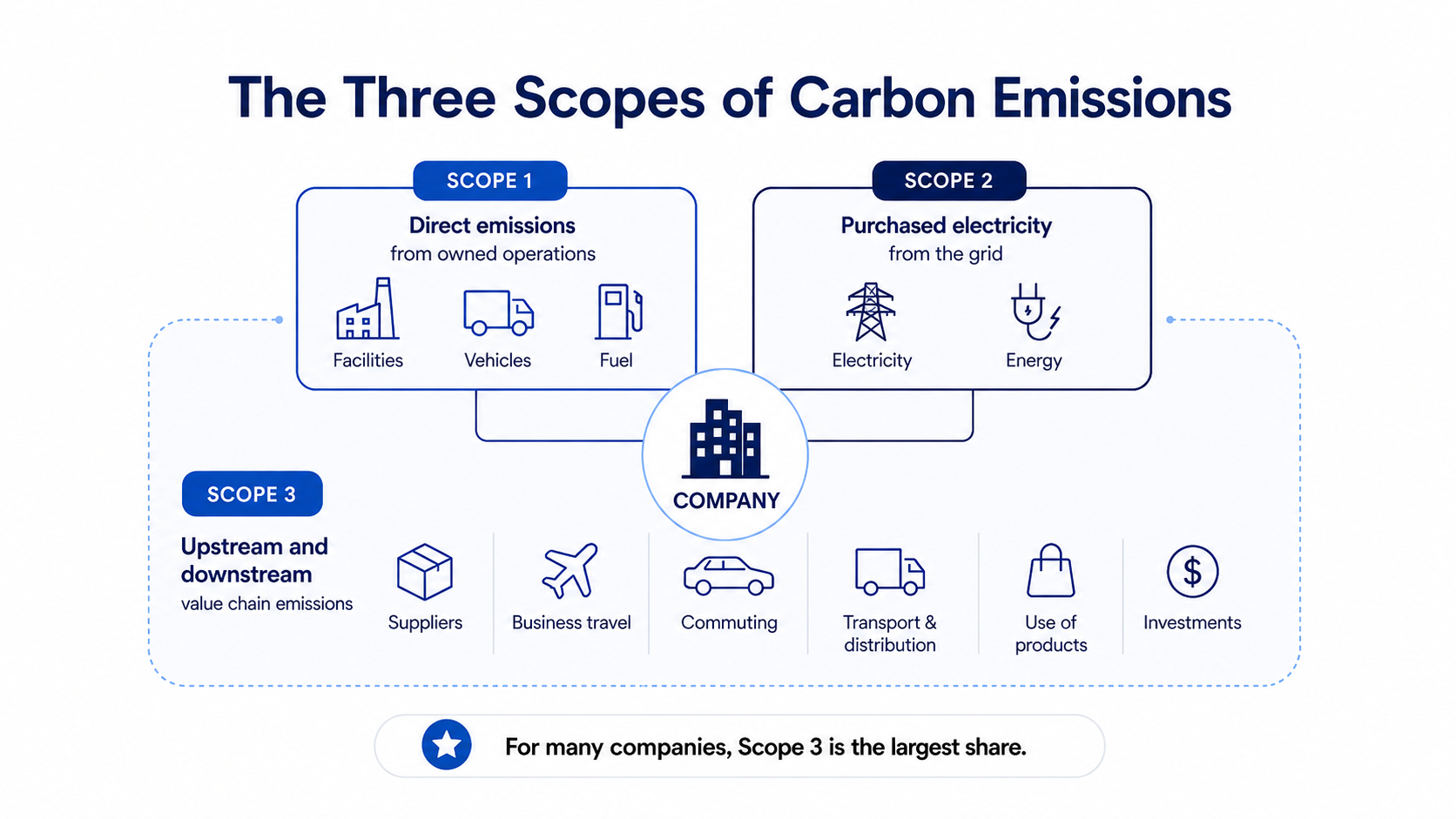
The GHG Protocol defines three scopes for emissions accounting, and this framework forms the backbone of corporate carbon accounting worldwide. Emissions are categorized into three scopes: Scope 1, Scope 2, and Scope 3. Together, they capture every source of GHG emissions linked to an organisation’s activities.
Here’s a quick summary:
- Scope 1 covers direct emissions from sources you own or control
- Scope 2 covers indirect emissions from purchased electricity, heat, steam, or cooling
- Scope 3 captures all other indirect greenhouse gas emissions across the value chain, both upstream and downstream
The proportions matter significantly. In many sectors, especially those with large supply chains, consumer products, tech, and finance, Scope 3 often represents 70–90% of total emissions. Regulators under frameworks like the EU CSRD, ISSB standards (IFRS S2), and Singapore’s climate reporting rules increasingly expect disclosure across all three scopes, particularly where Scope 3 emissions are material.
Scope 1: Direct Emissions from Your Own Operations
Scope 1 emissions are direct emissions from owned sources. These come from equipment and assets that your organisation owns or directly controls. Common examples include:
- Natural gas burned in boilers or furnaces for heating
- Diesel or petrol used in company-owned vehicles and backup generators
- Fugitive emissions from refrigerant leaks in air conditioning systems
- Process emissions from chemical reactions in manufacturing
- Propane or LPG used in onsite kitchens or canteens
For a small office-based business, Scope 1 might be limited to fuel for a few company vehicles and refrigerant top-ups for the HVAC system. For a manufacturer or logistics operator, it includes process heat, fleet fuel, and potentially significant fugitive gas losses.
These are typically the easiest emissions to measure and control because they happen on your premises, under your direct operational control. Data collection involves fuel purchase records, utility meter readings, vehicle mileage logs, and maintenance records for refrigeration equipment.
Scope 2: Indirect Emissions from Purchased Electricity, Heat, and Cooling
Scope 2 emissions are indirect emissions from purchased energy, specifically the electricity, steam, heating, and cooling your organisation buys and consumes. Even though these emissions physically occur at the power plant rather than at your office, they exist because of your energy consumption demand.
The GHG Protocol provides two methods for calculating Scope 2:
- Location-based method: uses the grid-average emission factor for your region. If your office in Singapore draws 100 MWh from SP Group, you multiply by Singapore’s grid emission factor (roughly 0.4 kg CO₂e/kWh) to get approximately 40 tonnes CO₂e.
- Market-based method: reflects your specific energy procurement decisions. If that same office has contracted solar energy through a green tariff or holds Renewable Energy Certificates (RECs), the market-based figure could drop by 20–70% or more, depending on the contract’s coverage.
Regulators and reporting standards increasingly require companies to disclose both methods for transparency. The location-based figure shows the reality of the grid you draw from; the market-based figure shows the impact of your procurement choices. The GHG Protocol’s Scope 2 guidance is currently under revision, with updated standards expected in 2027.
Scope 3: Value Chain and Supply Chain Emissions
Scope 3 emissions are indirect emissions from the supply chain and broader value chain, covering everything that isn’t captured in Scopes 1 or 2. Scope 3 emissions include those from suppliers and product use, making them the most complex and data-intensive category.
Scope 3 emissions often represent the largest portion of a company’s total emissions. Research consistently shows that Scope 3 emissions account for 5.5 times more emissions than Scope 1, which means that companies ignoring this scope are missing the vast majority of their climate impact.
The GHG Protocol breaks Scope 3 into 15 categories. For services and fintech businesses, the most relevant include:
- Purchased goods and services (office supplies, cloud infrastructure, consulting)
- Capital goods (IT hardware, office fit-outs)
- Business travel (flights, hotels, taxi rides)
- Employee commuting (daily transport to and from work)
- Use of sold products (for companies that sell physical or digital goods)
- Investments and financed emissions (loans, equity holdings, for financial institutions)
- Upstream and downstream transportation and distribution
Accurate data collection is crucial for managing supply chain emissions, but the reality is messy. Suppliers may not track or share their own emissions data. Cloud providers may not disclose energy consumption per customer. Converting financial data into emissions estimates requires emission factors that may be generic rather than specific. For a deeper look at tackling this challenge, see this guide on how to calculate Scope 3 emissions.
Engaging suppliers can significantly reduce Scope 3 emissions by improving data quality and creating shared incentives for carbon reduction. Financed and facilitated emissions from loan portfolios will increasingly be scrutinised by regulators and investors under standards like PCAF.
The Greenhouse Gas Protocol and Other Key Standards
The GHG Protocol is the most widely used carbon accounting standard globally. Developed by the World Resources Institute and the World Business Council for Sustainable Development in the early 2000s, it provides the foundational framework for greenhouse gas accounting, sometimes also called greenhouse gas accounting in regulatory and industry language.
The Protocol’s core principles are relevance, completeness, consistency, transparency, and accuracy. These mirror the rigour expected in financial accounting and ensure that emissions data is comparable across organisations and reporting periods.
Several other standards and frameworks build on or align with the GHG Protocol:
- ISO 14064 provides guidelines for greenhouse gas accounting and reporting at the organisational and project level. ISO and the GHG Protocol recently announced a strategic partnership to deliver unified global standards.
- The Science Based Targets Initiative (SBTi) validates corporate emissions reduction targets aligned with 1.5°C pathways, requiring robust GHG Protocol-aligned inventories as a baseline.
- The Carbon Disclosure Project (CDP) operates the world’s largest environmental disclosure platform, used by thousands of companies to report their carbon data annually.
- ISSB/IFRS S2 sets out climate disclosure requirements that reference GHG Protocol scopes, with targeted amendments effective from 2027.
- ESG frameworks require companies to disclose their GHG emissions, and most reference the GHG Protocol as the underlying methodology.
Most carbon accounting software platforms are built to comply with GHG Protocol categories and calculation rules, ensuring your reporting is standards-aligned from day one.
Carbon Accounting Methods: Spend-Based, Activity-Based, and Hybrid
Calculating GHG emissions typically involves multiplying business activity data by emission factors. The question is what kind of data you start with. Carbon accounting uses spend-based and activity-based methodologies, with most companies eventually landing on a combination of both. Here are the three main methods of carbon accounting:
- The spend based method estimates emissions based on financial data. You take how much you spent in each procurement category (e.g., S$50,000 on cloud services) and multiply by an “emissions per dollar” factor derived from sector averages. This method estimates emissions using financial data and emission factors. It’s fast, cheap, and works when you don’t have physical consumption data. The downside: lower accuracy and limited ability to identify specific reduction opportunities.
- The activity-based method tracks actual activities to calculate emissions. Instead of dollars, you use physical quantities: kWh of electricity, litres of fuel, kilometres driven, kilograms of packaging material. Combined with specific emission factors, this delivers far higher accuracy and enables targeted reduction strategies. The trade-off is that it requires more granular data collection.
- The hybrid method combines spend-based and activity-based approaches. You use activity data where it’s available and reliable (typically Scope 1, Scope 2, and your biggest Scope 3 categories), and fill remaining gaps with spend-based estimates. This is the pragmatic middle ground.
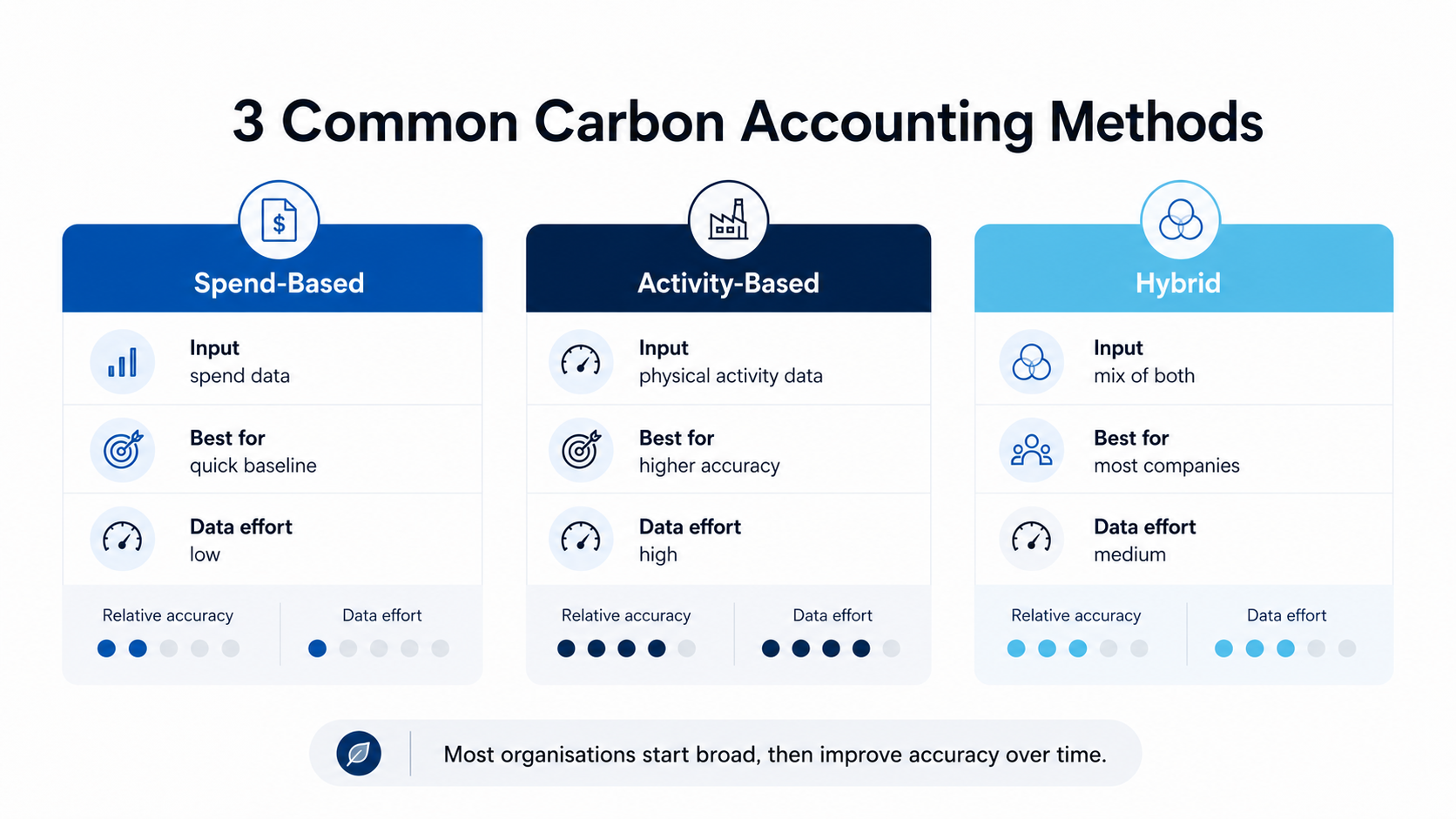
Most companies evolve from spend-based to hybrid over three to five reporting cycles as their sustainability data infrastructure matures and supplier engagement deepens. Starting with the spend based method for an initial baseline is perfectly acceptable. What matters is that you document your approach and improve data quality over time.
How the Carbon Accounting Process Works Step by Step
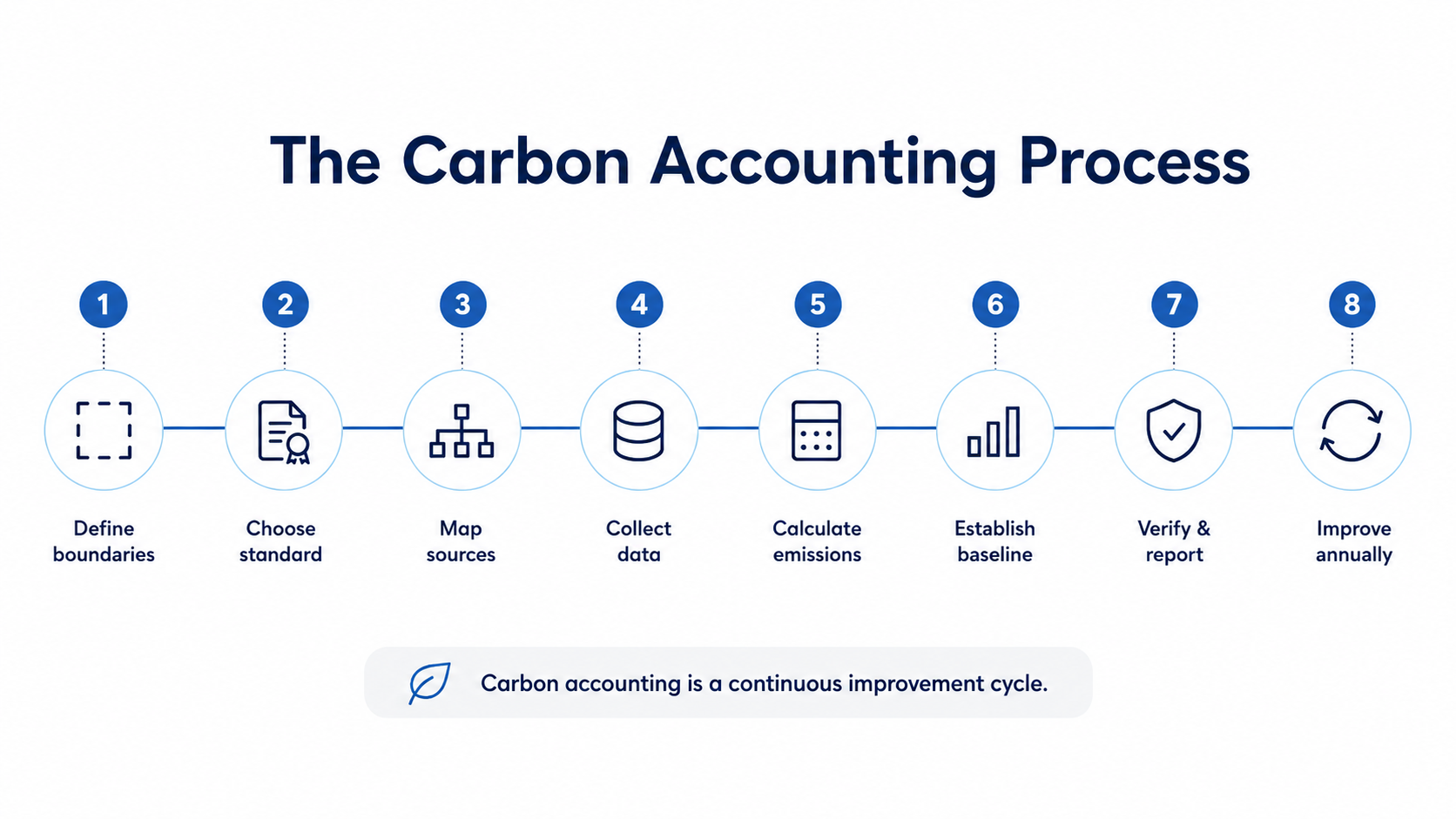
The carbon accounting process follows a logical sequence similar to preparing financial statements. Here’s a practical roadmap:
- Define organisational boundaries and reporting year. Organisations should define boundaries of operations for effective carbon accounting, deciding whether to use operational control or equity share approaches. Choose your reporting period (typically aligning with your financial year).
- Select your standard. The GHG Protocol Corporate Standard is the default choice for most companies. Confirm which version of GWP values your jurisdiction requires (most still use IPCC AR5).
- Map emissions sources. Walk through your operations and value chain to identify every relevant source of GHG emissions across Scopes 1, 2, and 3. This usually involves cross-functional input from facilities, procurement, finance, HR, and IT.
- Collect data. Gather utility bills, fuel invoices, travel expense claims, procurement records, fleet logs, and supplier information. Effective carbon accounting requires robust data management and quality control.
- Calculate emissions. Multiply activity data or financial spend by the appropriate emission factors. Use location-based and market-based methods for Scope 2. Apply GWP conversion factors where needed.
- Establish your baseline. Establishing baseline emissions is crucial for tracking progress over time. Your first inventory becomes the reference point against which all future reductions are measured.
- Review, verify, and report. Conduct internal quality checks, then consider external verification. Publish results in your sustainability report, regulatory filings, or CDP submission.
- Improve annually. Annual carbon accounting should follow a cycle of continuous improvement. Upgrade from spend-based to activity-based data where possible, expand Scope 3 coverage, and refine emission factors each year.
 A practical timeline: a company preparing its 2025 emissions inventory would typically collect data in Q1–Q2 2026, run carbon calculations in Q3, and publish or file by mid-to-late 2026.
Data Collection: The Foundation of Reliable Carbon Accounting
Data collection is the single biggest determinant of whether your carbon accounting produces accurate emissions data or misleading estimates. Without reliable inputs, even the best methodology won’t save you.
Typical internal data sources include:
- Utility bills (electricity, gas, water) for office and operational sites
- Fuel invoices and fleet management systems for company vehicles
- Expense claims and corporate card transactions for business travel
- Procurement and ERP systems for purchased goods and services
- HR and IT records for employee commuting and remote working estimates
- Cloud service provider usage reports for digital infrastructure emissions
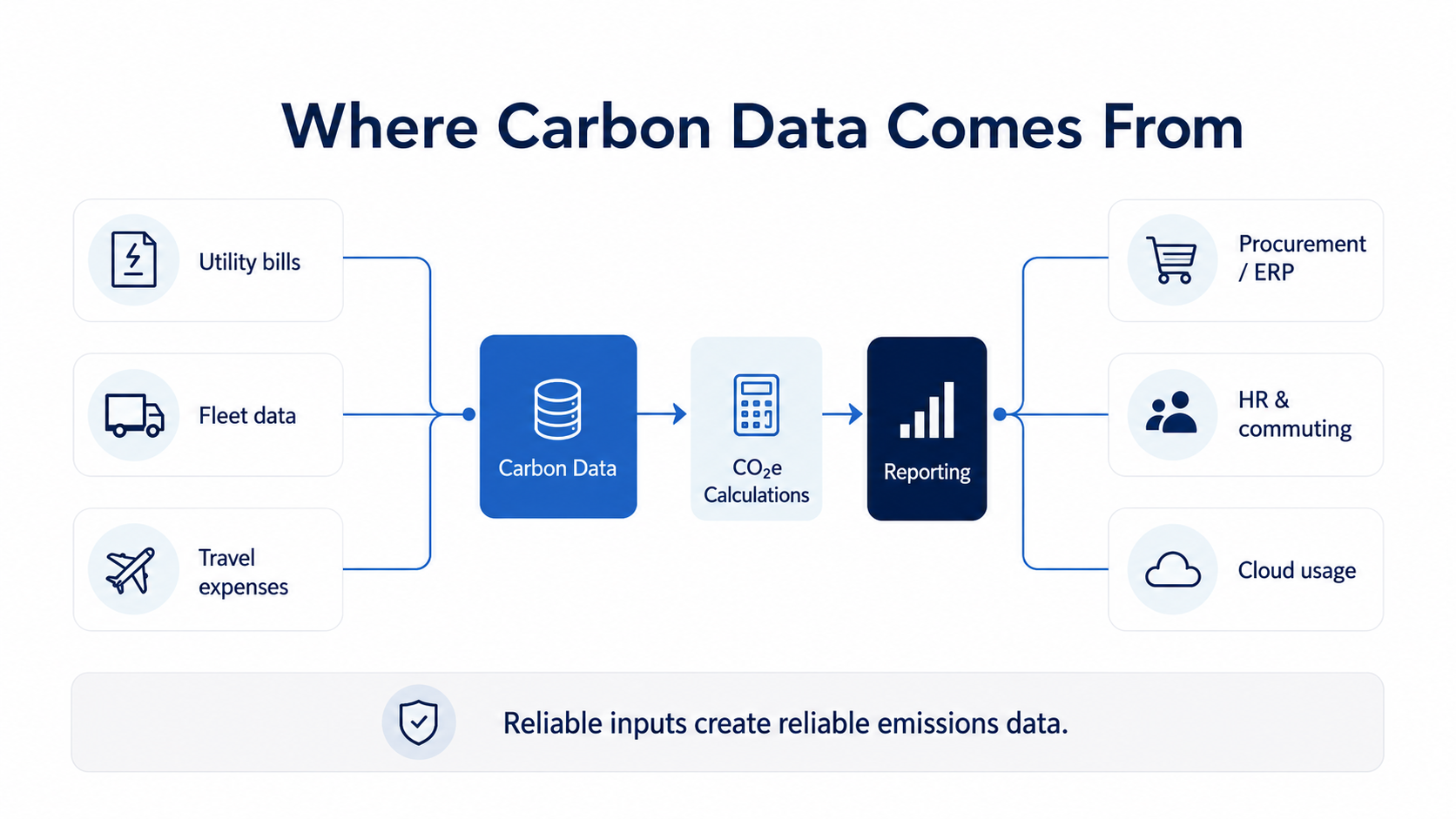
Strategies to improve data quality include:
- Deploying standard templates for suppliers with minimum required data fields
- Building emissions data requirements into procurement contracts
- Centralising all emissions data in one system rather than scattered spreadsheets
- Periodically validating against official emission factor databases from the IPCC, IEA, or national agencies like Singapore’s NEA
Common pain points are real: missing utility data for leased sites, inconsistent units across regions, and limited supplier transparency in complex supply chains. ESG software and carbon accounting platforms can automate much of this data collection and dramatically reduce manual errors.
Tools and Carbon Accounting Platforms
A carbon accounting platform is cloud-based software that automates data collection, emissions calculations, and carbon reporting according to recognised standards like the GHG Protocol. These tools replace error-prone spreadsheets with audit-ready workflows.
Core features to look for in a carbon accounting platform:
- Integration with finance and ERP systems for automated data import
- Built-in emission factor libraries covering multiple regions and sectors (including Singapore-specific grid factors)
- Support for all 15 Scope 3 categories with both spend-based and activity-based calculation options
- Audit trails with versioning and approval workflows, similar to financial reporting controls
- Dashboard views for emissions tracking across business units, time periods, and scopes
- Export capabilities for CDP, CSRD, ISSB, and other regulatory submissions
The difference between generic ESG tools and specialised carbon accounting software lies in calculation depth and audit readiness. A specialised platform handles nuanced accounting rules (market-based vs location-based Scope 2, allocation of financed emissions, supplier-specific factors) that a generic tool may gloss over. For a comparison of leading options, see this review of the evolution of carbon accounting software.
For Credibl’s context, robust carbon data from borrowers can support green or sustainability-linked loan products by providing verified emissions baselines and reduction pathways.
Why Invest in Carbon Accounting? Business and Financial Benefits
Carbon accounting isn’t just a regulatory checkbox. It delivers tangible business value across multiple dimensions:
Compliance and risk reduction:
- Carbon accounting reduces regulatory risks for businesses by ensuring readiness for frameworks like the EU CSRD, California SB 253/261, and Singapore’s climate reporting roadmap.
- Carbon accounting helps organisations meet regulatory compliance requirements before deadlines hit, avoiding penalties and reputational damage.
Operational efficiency and cost savings:
- Accurate carbon data drives operational efficiency and cost savings by revealing where energy, fuel, and materials are being wasted.
- Transparent carbon accounting helps in identifying emission hotspots that often correlate with cost hotspots.
- Companies using carbon accounting can optimise supply chains effectively, finding lower-cost, lower-carbon suppliers and logistics routes.
Reputation and stakeholder trust:
- Carbon accounting enhances brand trust and reduces greenwashing risks by providing verifiable, standardised numbers rather than vague claims.
- ESG performance increasingly influences investment decisions, partner selection, and consumer loyalty.
Access to finance:
- Banks and alternative lenders are tying loan terms to sustainability metrics. Having a credible emissions baseline makes you eligible for sustainability-linked loans with preferential rates.
-
Smaller businesses in Singapore can use carbon accounting to stand out when applying for financed emission through platforms like Credibl, demonstrating not just financial health but environmental credibility.
Risk management:
- Understanding climate risk exposure, from carbon pricing to supply chain disruptions and transition risks, helps companies anticipate threats that affect long-term borrowing capacity and operational viability.
Limitations and Common Challenges in Carbon Accounting
No measurement system is perfect. Here are the most common obstacles:
- Incomplete data remains the top challenge. Many organisations lack reliable consumption data for certain sites, suppliers, or Scope 3 categories.
- Inconsistent methodologies over time can make year-on-year comparisons unreliable. When emission factor databases update or standards change (e.g., moving from IPCC AR5 to AR6 GWP values), prior inventories may need restatement.
- Reliance on generic emission factors means that spend-based estimates for supply chain emissions can over- or understate actual impact significantly.
- Limited supplier engagement creates data blind spots. Without collaboration, your Scope 3 numbers remain rough approximations.
- Lack of internal expertise is common, especially among SMEs where sustainability teams are small or non-existent, and budgets for consultants or software compete with core business priorities.
- Risk of greenwashing arises when assumptions aren’t transparent, when companies selectively report only Scopes 1 and 2 while ignoring Scope 3, or when carbon offsets are overstated in place of actual reduction.
The practical response to these challenges isn’t perfection on day one. Start with best available data, document every assumption, adopt a hybrid method, and commit to yearly improvement. Regulators and auditors understand that carbon accounting matures over time-what they penalise is inaction.
From Measurement to Action: Using Carbon Accounting to Reduce Emissions
Measuring is only the first step. The ultimate goal of the carbon accounting process is reducing carbon emissions and meeting meaningful net zero targets aligned with climate science. It provides data to inform and implement emissions reduction plans.
Actions informed by carbon accounting include:
- Switching to renewable electricity contracts to cut Scope 2 emissions (often the fastest win)
- Optimising logistics and transportation routes to reduce fleet fuel consumption
- Engaging suppliers on their own emissions, setting procurement criteria that favour lower-carbon options
- Shifting to lower-carbon cloud providers or consolidating data centre usage
- Redesigning products or services to lower use-phase and end-of-life emissions
- Integrating carbon metrics into budgeting and investment decisions so finance teams prioritise high-impact reduction projects
Science-based targets, validated by the Science Based Targets Initiative, give companies a credible pathway to align their reduction strategies with 1.5°C warming limits. Achieving SBTi validation requires a robust greenhouse gas emissions baseline and ongoing annual carbon accounting.
For lending and fintech platforms, there’s an additional lever: lenders may use borrowers’ emissions data to price sustainability-linked loans or offer preferential terms for borrowers with clear decarbonisation plans. This creates a financial incentive loop where accurate carbon accounting directly reduces borrowing costs.
Carbon Accounting in Financial Services and Fintech (Including Credibl’s Lens)
Banks, lenders, and fintechs face growing pressure to measure financed emissions, the GHG emissions generated by the businesses and individuals they finance. Under the PCAF standard (now in its third edition as of 2025), financial institutions must account for emissions across asset classes including business loans, mortgages, and motor vehicle loans. This falls under Scope 3 Category 15 of the GHG Protocol and represents one of the most material emission categories for any financial institution. For banks navigating this space, financed emissions management tools are becoming essential infrastructure.
Credibl can incorporate carbon considerations in several practical ways:
- Encouraging borrowers to share basic sustainability data when applying for loans, creating a richer picture of borrower profiles
- Partnering with lenders who offer better rates for low-carbon purchases (energy-efficient home upgrades, EV purchases, solar installations)
- Helping individual borrowers understand the emissions associated with financed purchases through simple calculators or educational content alongside their financial data
There’s also a risk management dimension. Borrowers exposed to rising energy costs, carbon taxes (Singapore’s carbon tax rises to S$45/tCO₂e in 2026–27 and targets S$50–80 by 2030), or climate-related business disruptions carry transition risks that affect their long-term repayment capacity. Understanding a business’s carbon footprint becomes part of understanding its credit risk.
Over the 2026–2030 period, expect consumer platforms to increasingly blend sustainability data with personal finance tools, helping individuals see their carbon footprint alongside their financial health.
How to Get Started with Carbon Accounting in Your Business
Starting your carbon accounting journey doesn’t require a massive budget or a team of consultants. Here’s a practical “first 90 days” roadmap:
- Assign ownership. Designate a person or small team responsible for the initiative. This could be someone in finance, operations, or sustainability, but they need executive backing and cross-functional access.
- Choose your standard. The GHG Protocol Corporate Standard is the default for most organisations. Confirm which regulatory requirements apply to your business (SGX, CSRD, or voluntary).
- Map your emissions sources. Walk through your operations and list every source of energy consumption, fuel use, travel, and major purchased services. Start with what you know.
- Pilot a simple inventory. Use the spend based method for your first pass. Pull financial data from your accounting system, apply sector-average emission factors, and calculate an initial baseline. This won’t be perfect, and that’s fine.
- Prioritise Scope 1 and Scope 2 first. These are under your direct control and use the most reliable data. Then add the most material Scope 3 categories: purchased goods and services, business travel, and cloud services.
- Document everything. Record your boundaries, assumptions, data sources, and methods from the outset. This makes future audits, verification, and regulatory submissions dramatically easier.
- Plan your upgrade path. Identify which categories to move from spend-based to activity-based in year two. Build emissions data requirements into supplier contracts and procurement processes.
- Seek external support when needed. Consultants, industry associations, or carbon accounting software providers can accelerate your progress, especially for Scope 3 and regulatory alignment.
Early, even imperfect, carbon accounting is always better than waiting. The businesses that start measuring now will be the ones best positioned for mandatory regulations, lower-cost sustainable financing, and genuine competitive advantage.
Carbon accounting enables businesses to transform climate risk into strategic opportunity. Carbon accounting enables organisations to meet stakeholder expectations while also unlocking cost savings, operational efficiency, and access to green finance. Whether you’re a listed company facing mandatory disclosure or a growing SME exploring your first sustainability report, the time to begin is now.