


By mid-2026, ESG reporting requirements have intensified across the EU, Australia, California, and ISSB-aligned jurisdictions, but timelines and scope vary significantly by regime. In the EU, Omnibus changes have narrowed CSRD scope and reset the practical reporting landscape for companies beyond the first wave.
In Australia, Group 1 climate reporting is underway under AASB S2, with Group 2 beginning from financial years starting 1 July 2026. In California, CARB has begun implementing SB 253 for U.S.-based entities doing business in the state above the revenue threshold, with first-year Scope 1 and 2 reporting due in August 2026.
Dozens of jurisdictions have adopted, used, or are progressing toward ISSB-aligned sustainability disclosure requirements, including IFRS S1 and S2.
For CFOs and heads of risk at listed companies, ESG reporting is no longer a communications exercise managed by the sustainability team. It is a disclosure obligation subject to external assurance, audit committee oversight, and potential regulatory penalty if the data does not hold up under scrutiny.
The software decision that underpins this is a finance and risk decision, not just a procurement call.
This guide covers the 10 leading ESG reporting platforms in 2026, written for CFOs, heads of risk, and board-level operators evaluating platforms for the first time or stress-testing existing tools against current regulatory requirements.
One distinction upfront: ESG reporting software covers the full environmental, social, and governance picture. It handles data collection, framework alignment, audit trails, and multi-stakeholder disclosure across all three pillars.
It is different from carbon accounting software, which focuses specifically on greenhouse gas measurement and Scope 1, 2, and 3 calculations. If GHG measurement is your primary need, our carbon accounting software guide covers that category separately.
Quick comparison: Top 10 ESG reporting platforms in 2026
| Platform | Best For | Core Differentiator | Primary Pros | Key Considerations |
|---|---|---|---|---|
| Credibl | Mid-market to enterprise, multi-jurisdiction reporting | Unified E+S+G data backbone with “do once, report many” across CSRD, IFRS S1/S2, BRSR, SB 253 | AI ingestion, full source-linked auditability, multi-framework from one dataset | Built for serious ESG programmes; may be over-specified for basic single-framework compliance needs |
| Workiva | Listed companies and CFOs integrating ESG into financial reporting | ESG data inside the same audit control environment as financial statements | Version control, audit trails, SEC and CSRD reporting | Not a deep carbon calculation engine; typically paired with a separate emissions platform |
| IBM Envizi | Multinationals with large, distributed facility portfolios | Facility-level energy and emissions data aggregation at scale | Real-time energy analytics, comprehensive Scope 2 treatment | Complex deployment; dated interface; implementation may require specialist support |
| Diligent ESG | Listed companies managing board-level ESG governance | GRC and ESG in one platform; Persefoni powers the carbon layer | Board and audit committee workflows integrated with ESG data | Two vendor dependencies; implementation timeline reflects both platforms |
| Persefoni | Large enterprises and financial institutions | Audit-grade carbon accounting aligned to GHG Protocol and PCAF | SOC 1 and SOC 2 certified; strong financed emissions capability | Complex interface; premium pricing; primarily carbon-focused rather than full ESG |
| Sweep | European and EU-US multinationals | CSRD-first architecture mapping to multiple frameworks from one dataset | Native CSRD, ISSB, GRI, CDP, and SB 253 support | May be over-engineered for standalone US-only compliance programmes |
| Watershed | Global enterprises with complex supply chains | Activity-based Scope 3 methodology depth across all 15 categories | Assurance-oriented commercial guarantee; strong supplier engagement tools | Requires a mature sustainability team; not suited to early-stage ESG programmes |
| SAP Sustainability Control Tower | Large SAP-ecosystem enterprises | ESG metrics derived directly from existing ERP data structures | Deep SAP integration; strong CSRD and ESRS coverage; AI-assisted report drafting | Limited value without significant SAP infrastructure already in place |
| Sphera | Industrial and manufacturing sectors | LCA database depth combined with EHS and operational risk management | Precise Scope 3 product-level tracking; direct EHS integration | Designed for heavy industry; complex implementation; less suited to services or tech companies |
| Novisto | Mid-to-large enterprises managing multi-framework ESG disclosure | ESG data management with strong framework mapping, benchmarking, and workflow automation | Intuitive platform; strong implementation support; multi-framework coverage | Less suited to deep GHG calculation needs; benchmarking becomes complex with large peer sets |
What is ESG reporting software?
ESG reporting software is a digital platform that helps organisations collect, manage, validate, and disclose data across the three pillars of Environmental, Social, and Governance performance.
On the environmental side, it handles emissions tracking, energy consumption, water usage, and waste. On the social side, it covers workforce metrics, supply chain labour practices, and community impact indicators. On the governance side, it manages board composition data, ethics and compliance frameworks, and transparency disclosures to regulators and investors.
The distinction from carbon accounting software matters for buyers: Carbon accounting platforms focus specifically on greenhouse gas measurement and Scope 1, 2, and 3 calculations. ESG reporting software is the broader system that manages all non-financial disclosure, with carbon data as one input among many. Many organisations use both, with the carbon accounting tool feeding data into the ESG reporting platform. If you are evaluating tools specifically for GHG measurement, our carbon accounting software guide covers that category in detail.
Why listed companies cannot manage ESG on spreadsheets in 2026
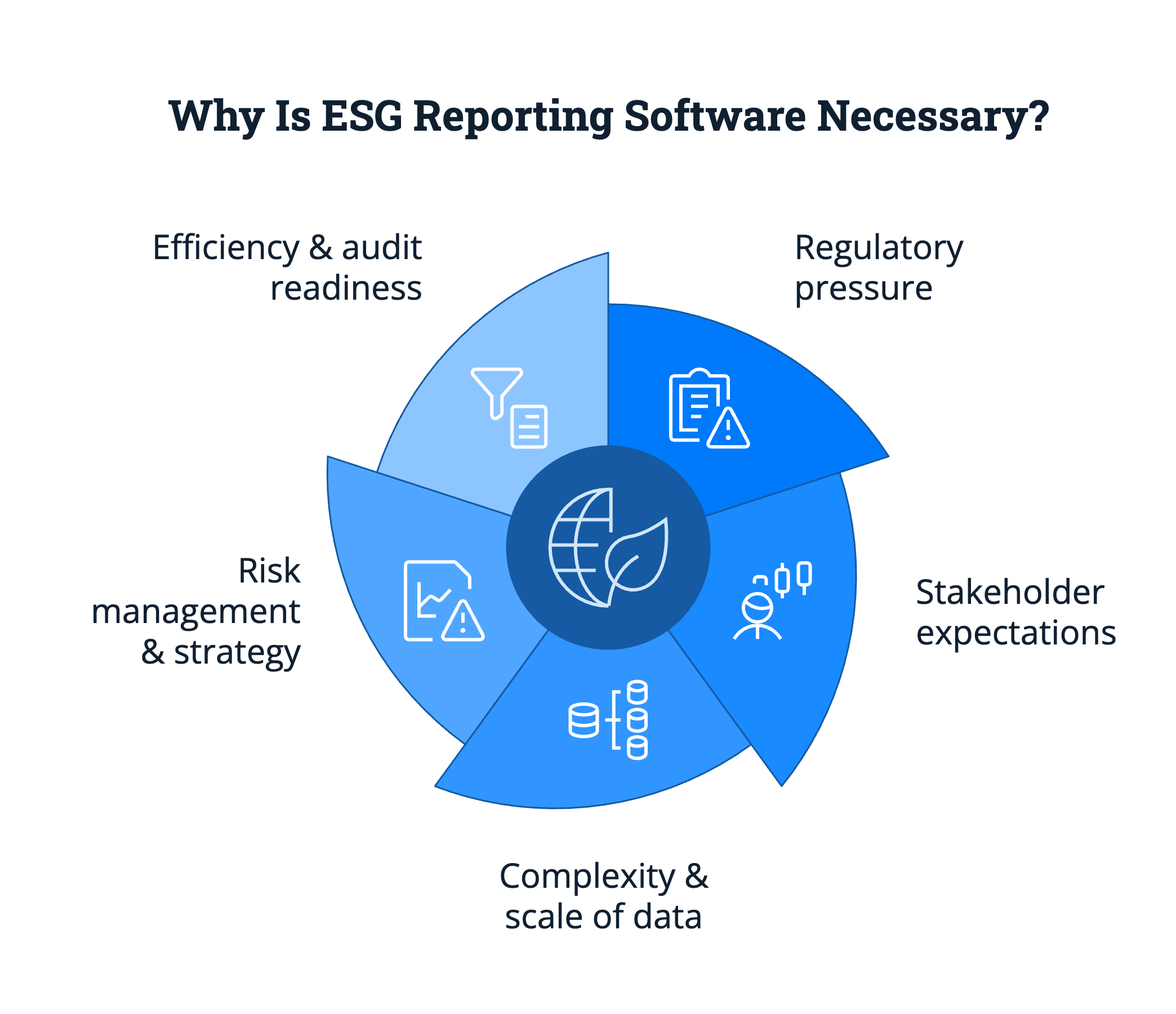
Four reasons this matters for CFOs and heads of risk specifically.
Regulatory exposure is becoming more material across major reporting jurisdictions. CSRD requirements in 2026 are being reshaped by the Omnibus, with substantial obligations remaining for in-scope companies. In Australia, AASB S2 reporting is live for Group 1 entities. In California, SB 253 reporting obligations are being implemented by CARB, with first-year Scope 1 and 2 reporting due in August 2026, covering U.S.-based entities doing business in the state above the revenue threshold. For in-scope entities, these disclosures are mandatory.
ESG and climate data is increasingly subject to assurance requirements or assurance-readiness expectations. External auditors are applying the same document traceability standards to sustainability data that they apply to financial statements. Spreadsheet-managed data cannot produce the evidence trails required for limited or reasonable assurance without significant additional manual work at audit time.
Multi-jurisdiction complexity compounds quickly. A company reporting under CSRD, IFRS S2, and SB 253 simultaneously is managing three different framework requirements against the same underlying data. Without software that maps data to multiple frameworks from a single dataset, every reporting cycle becomes a duplication exercise that multiplies error risk.
Data volume at scale breaks manual workflows. Scope 3 emissions alone can require primary data from hundreds of suppliers. Social metrics require HR system integration. Governance data requires board-level inputs and sign-off workflows. No spreadsheet-based process manages this reliably across a listed enterprise.
What leading ESG reporting platforms actually do, and where they fall short
1. Credibl ESG
Best for: Mid-market to enterprise companies managing ESG reporting obligations across multiple regulatory frameworks and jurisdictions simultaneously.
The core case: Credibl builds a unified data backbone across all three ESG pillars, so the same underlying dataset populates CSRD/ESRS, IFRS S1/S2, BRSR, TCFD, and SB 253 reports without rebuilding data structures for each framework. The platform is designed around auditability i.e. every data point is traceable to its source document, calculations are version-controlled and designed for high auditability, and every workflow carries an approval layer before data reaches a disclosure.
Right for you if:
- You are managing ESG reporting obligations across more than one regulatory regime and need a single dataset to serve all of them without manual reformatting between frameworks
- You need sustainability data held to finance-grade standards, traceable, versioned, and defensible under external assurance across environmental, social, and governance metrics
Not the right fit if:
- You are a startup or micro-business looking for a lightweight tool to meet a single disclosure requirement
- Your ESG programme is still in its earliest stages and does not yet have the data infrastructure to benefit from a unified, multi-framework platform
2. Workiva
Best for: Publicly listed companies and CFOs who need ESG disclosures to sit inside the same audit control environment as financial statements.
The core case: Workiva connects non-financial ESG disclosures to financial statements, SEC filings, and annual reports in one governed platform. For listed companies where ESG data is increasingly subject to the same assurance scrutiny as financial data, that integration removes the biggest source of restatement risk. Version control, role-based permissions, and time-stamped audit trails give the finance team the same governance over ESG figures that it expects over financial ones.
Right for you if:
- Your finance team is preparing SEC, CSRD, or ISSB-aligned reports and needs ESG data held to the same version control and audit trail standard as financial disclosures
- You are already using Workiva for financial or regulatory reporting and want to extend that control infrastructure to sustainability without introducing a separate vendor environment
Not the right fit if:
- You need a deep carbon calculation engine natively; Workiva is a reporting and disclosure layer that typically pairs with a dedicated emissions platform such as Persefoni for the calculations underneath
- You are evaluating ESG software independently of a broader financial reporting stack; the pricing and implementation complexity are harder to justify for ESG use alone
3. IBM Envizi
Best for: Multinational corporations and facility managers requiring centralised energy and emissions data across large, geographically distributed operations.
The core case: IBM Envizi was engineered to handle the data volume generated by thousands of global facilities, making it the most reliable option for normalising and aggregating Scope 1 and 2 data across multiple energy grids, utility providers, and geographies. It supports large-scale emissions-factor management across multiple geographies and applies automated market-based and location-based treatment for grid electricity.
Right for you if:
- You manage hundreds of facilities across multiple countries and need real-time utility data flowing into a single, auditable platform with genuine Scope 2 treatment depth
- Your primary ESG reporting obligation is emissions intensity across real estate, infrastructure, or energy-intensive operations where facility-level granularity is non-negotiable
Not the right fit if:
- You need an intuitive, modern interface that non-technical teams can navigate without heavy onboarding; the platform reflects its legacy enterprise architecture and implementation may require specialist support, especially in complex enterprise environments
- Your primary need is Scope 3 supplier engagement, social metrics, or broader governance reporting beyond the environmental pillar
4. Diligent ESG
Best for: Listed companies where ESG governance sits within the board’s risk and compliance agenda, not only the sustainability team’s workplan.
The core case: Diligent approaches ESG from a governance-first direction. The platform manages board reporting, GRC workflows, and ESG disclosure in an integrated environment, with Persefoni providing the carbon accounting engine underneath. For companies where the audit or risk committee owns sustainability oversight, this integration brings ESG data into the same governance infrastructure as director information management, board evaluations, and regulatory compliance tracking.
Right for you if:
- You need sustainability data and governance workflows managed in the platform your board and audit committee already use, so that ESG sits alongside GRC rather than operating as a separate programme
- Your primary reporting driver is board-level accountability and audit committee oversight of sustainability data, not a standalone sustainability team deployment
Not the right fit if:
- You want a single vendor for both ESG data management and carbon accounting; Diligent relies on Persefoni for the emissions layer, which introduces two vendor dependencies and two implementation timelines before any filing deadline
- You need deep social or environmental data collection capabilities beyond what a governance-oriented platform prioritises as its core use case
5. Persefoni
Best for: Large enterprises and financial institutions where carbon accounting methodology compliance and third-party assurance are the primary requirements.
The core case: Persefoni applies financial accounting discipline to emissions data. Its proprietary Footprint Ledger carries SOC 1 and SOC 2 certifications and is aligned to GHG Protocol and PCAF standards for financed emissions, making it a strong platform for asset managers and banks calculating emissions across loan books and investment portfolios. The platform is positioned around rigorous carbon-accounting methodology and support for major disclosure use cases.
Right for you if:
- You are in financial services managing financed emissions under PCAF guidelines and need an audit posture that satisfies institutional investors and external assurance providers
- Your primary requirement is methodology rigidity and third-party assurance readiness, and you have the internal technical capacity to manage a complex deployment
Not the right fit if:
- You need an intuitive, fast-to-deploy platform; users consistently flag complex navigation and manual data entry as friction points
- You need broader ESG data management covering social and governance metrics at the same depth as the environmental and emissions pillar
6. Sweep
Best for: European companies and EU-US multinationals managing CSRD/ESRS compliance across all three ESG pillars with US regulatory extensions included.
The core case: Sweep is built around CSRD’s multi-pillar disclosure requirements, covering environmental, social, and governance metrics in a single dataset that maps to multiple frameworks simultaneously. For companies running CSRD and either IFRS S2 or SB 253 in parallel, Sweep’s native support for all four frameworks from one dataset removes the need to rebuild data structures for each reporting cycle. Its supplier engagement workflows are the headline environmental capability, and a dedicated SB 253 Navigator tool is included at no additional cost.
Right for you if:
- You are a European company or EU-US multinational where CSRD is the primary obligation and you need the full three-pillar ESG data model covered, not just emissions
- Your supplier network is complex and requires structured, automated data collection workflows that handle both emissions requests and broader supply chain ESG due diligence
Not the right fit if:
- Your regulatory obligations are primarily US-based and you do not need the full CSRD data architecture; the platform’s depth can be over-engineered for a standalone SB 253 or IFRS S2 use case
- You are in the early stages of ESG programme development; the data model creates implementation overhead for companies still building baseline ESG infrastructure
7. Watershed
Best for: Global enterprises with complex, multi-tier supply chains where Scope 3 methodology depth is the primary reporting challenge.
The core case: Watershed supports all 15 Scope 3 categories with spend-based, activity-based, supplier-specific, and hybrid calculation approaches, giving it strong activity-based method depth in this category. It also markets an assurance-oriented commercial guarantee, which is unusual in this space.
Right for you if:
- Scope 3 accounts for the majority of your footprint and you need calculation methodology depth beyond spend-based estimates to withstand assurance scrutiny from external auditors
- You have an experienced internal sustainability team with the capacity to manage a platform whose implementation complexity and feature depth are sized for large enterprise programmes
Not the right fit if:
- You need a platform that covers social and governance reporting at comparable depth to its environmental capabilities; Watershed’s strength is concentrated in the climate and emissions pillar
- You are a smaller organisation without a dedicated sustainability data function; implementation timelines and feature depth are not suited to teams still building ESG basics
8. SAP Sustainability Control Tower
Best for: Large enterprises already standardised on SAP ERP where sustainability data can be derived directly from existing operational systems without building a separate data pipeline.
The core case: SAP positions the platform around ERP-connected sustainability reporting, particularly for SAP-centric enterprises. For companies running SAP ERP across finance, supply chain, and operations, sustainability metrics can be derived directly from existing data structures rather than re-entered into a separate platform, making the path to audit-ready ESG data significantly shorter for organisations already invested in the SAP ecosystem.
Right for you if:
- Your business runs on SAP ERP and you want sustainability data derived from operational systems, removing the need for a separate ESG data pipeline
- Your ESG reporting obligations centre on CSRD/ESRS and IFRS S1/S2, and you want AI-assisted report drafting within a familiar enterprise architecture
Not the right fit if:
- You do not have significant SAP infrastructure; extending the platform to non-SAP environments adds considerable integration complexity and cost that erodes the primary advantage
- You need a standalone, purpose-built ESG platform with deep supplier engagement portals, social metrics, or multi-jurisdiction flexibility beyond the SAP ecosystem
9. Sphera
Best for: Asset-heavy manufacturers and energy companies that need to connect factory-floor EHS compliance with corporate ESG reporting in a single system.
The core case: Sphera’s LCA database is one of the most extensive available commercially, making it a precise option for Scope 3 product-level emissions in manufacturing, chemicals, and energy sectors. For companies already running Sphera for EHS and operational risk management, extending into corporate ESG reporting avoids duplicating the operational data infrastructure these industries already maintain, and connects granular compliance metrics directly to board-level disclosure.
Right for you if:
- You are in heavy industry or manufacturing with complex Scope 3 product-level emissions and an existing Sphera EHS deployment that you want to extend into corporate ESG reporting
- You need ESG data that connects directly from operational safety and compliance systems, including waste, chemical management, and water usage, into board-level disclosure without a separate data collection layer
Not the right fit if:
- You are a services, technology, or finance company; the platform’s industrial depth creates unnecessary complexity and cost for organisations without significant physical operational footprints
- You need rapid time to first value; Sphera is a major enterprise implementation that requires significant internal resource alignment before any reporting output is delivered
10. Novisto
Best for: Mid-to-large enterprises that need to manage, benchmark, and disclose ESG data across multiple frameworks with a platform that sustainability and finance teams will actually adopt.
The core case: Novisto is a purpose-built ESG data management and reporting platform with strong framework mapping, peer benchmarking, and workflow automation across all three pillars. It maps a broad range of international frameworks and regulatory requirements to specific metrics within the platform, reducing the manual interpretation work that typically slows cross-functional reporting teams. User feedback often highlights implementation support and usability as strengths in a category where complexity is the default.
Right for you if:
- You need a platform covering all three ESG pillars with multi-framework mapping that can be adopted across sustainability, finance, and operations teams without a steep technical learning curve
- You want competitor benchmarking built into the platform at the metric level, so ESG performance can be contextualised against peers without a separate analytics layer
Not the right fit if:
- You need a purpose-built carbon accounting engine with deep GHG calculation methodology; Novisto’s strength is data management and framework reporting rather than granular emissions calculation depth
- You are comparing a large set of peers simultaneously; users note that the benchmarking function becomes less manageable as the comparison set grows beyond a handful of companies
How to choose the right ESG reporting platform
Five criteria that map directly to how finance and risk teams will use the tool in practice.
| Criterion | What to test in a demo |
|---|---|
| Framework and jurisdiction coverage | Ask the vendor to show how a single data point maps across CSRD, IFRS S2, and your primary regional obligation simultaneously. Platforms that claim multi-framework support but deliver templates rather than intelligent data mapping will cost your team weeks every reporting cycle. |
| Audit readiness and data lineage | Every material data point should be traceable to a source document with a timestamped approval workflow. If an external auditor cannot follow data from source to disclosure without a manual explanation, the platform is not audit-ready. |
| Integration with finance and ERP systems | ESG data that lives in a separate system from financial data creates reconciliation risk. Confirm out-of-the-box API connectivity to your ERP, HR systems, and utility providers before committing. |
| Social and governance metric depth | Most carbon-focused tools have shallow S and G coverage. If your obligations include ESRS social standards, BRSR workforce metrics, or board governance reporting, test those modules specifically before the environmental capabilities. |
| Multi-framework output without rebuilding datasets | Ask directly: if a regulation changes or a new framework is added, does the underlying data need to be restructured? The answer should be no. |
FAQs
What is the difference between ESG reporting software and carbon accounting software?
Carbon accounting software focuses specifically on measuring greenhouse gas emissions across Scopes 1, 2, and 3. It applies emission factors to activity data and produces GHG Protocol-aligned outputs. ESG reporting software covers the full picture: environmental data including but not limited to carbon, social metrics such as workforce and supply chain indicators, and governance data including board composition and compliance disclosures. Many organisations use both, with the carbon accounting platform feeding emissions data into the ESG reporting system.
How has the CSRD Omnibus changed ESG software selection in 2026?
The Omnibus I changes, finalised in early 2026, narrowed mandatory CSRD reporting to EU companies with more than 1,000 employees and net turnover exceeding €450 million, subject to national transposition. Under the revised timetable, Wave 2 companies that remain in scope start with FY 2027 reporting in 2028, while non-EU groups in scope start with FY 2028 reporting in 2029. For companies newly in scope under the revised thresholds, first reporting generally starts with financial years beginning on or after 1 January 2027.
Companies that fall outside the revised CSRD scope may no longer face direct mandatory reporting, though many will still face customer and value-chain data requests. Software selection should account for both direct regulatory obligations and supply chain disclosure demands.
Is ESG reporting software relevant for Australian companies under AASB S2?
Yes. Australia’s mandatory climate-related disclosure regime is live for Group 1 entities under AASB S2; AASB S1 is available as a voluntary standard for broader sustainability-related disclosures. Group 2 entities face mandatory reporting from financial years beginning 1 July 2026. Obligations cover climate-related governance, strategy, risk management, and metrics and targets, including emissions disclosures under AASB S2. Platforms with Australia-specific disclosure mapping may reduce implementation effort for in-scope entities.
How long does implementation typically take?
Implementation timelines vary by platform complexity and data readiness. Purpose-built mid-market platforms typically deliver a first auditor-ready dataset in 8 to 12 weeks. Enterprise platforms with ERP integration and multi-framework configuration run 12 to 20 weeks for full deployment. Companies with fragmented data infrastructure, multiple ERP systems, or complex supply chains should build an additional 4 to 8 weeks into any vendor timeline estimate.
What does audit-ready ESG data actually mean?
Audit-ready ESG data means every material data point is traceable to a source document, every calculation method is documented and version-controlled, and every approval in the workflow is time-stamped and attributable to a named user. An external auditor should be able to follow any figure in your ESG disclosure back to its origin without a verbal explanation from your team. If your current process requires a sustainability manager to narrate data provenance during an audit, the data is not audit-ready.
See how Credibl handles this
Credibl manages ESG reporting across CSRD, IFRS S1/S2, SB 253, BRSR, and more from a single data backbone. If you are evaluating platforms for the first time or stress-testing your current setup against 2026 reporting requirements: