

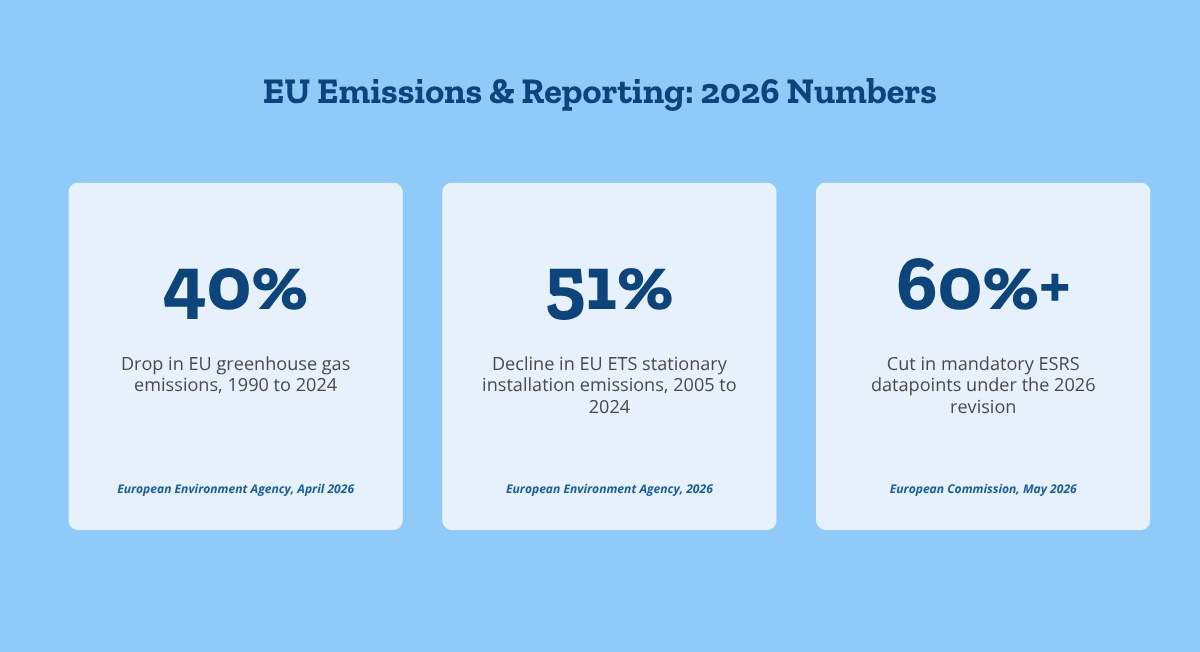
The regulatory ground under EU sustainability reporting shifted again this year. In May 2026, the European Commission published a revised draft of the simplified ESRS for consultation, reducing mandatory datapoints by over 60 percent and total datapoints by over 70 percent.
The Omnibus Directive, in force since March 2026, also raised the CSRD scope threshold, so that only companies with more than 1,000 employees and more than €450 million in net annual turnover must report.
For sustainability and EHS managers, this does not mean the pressure is off. If anything, it raises the bar on data quality for the datapoints that remain. At the same time, the EU’s own emissions data shows how much is riding on getting this right: greenhouse gas emissions across the EU fell 40 percent between 1990 and 2024, with emissions from stationary installations under the EU Emissions Trading System down 51 percent from 2005 to 2024.
Behind every one of those percentage points sits an organisation’s carbon footprint, built from thousands of individual data points: meter readings, fuel invoices, supplier records, and sensor feeds. That is where emissions management software comes in, and it is a different tool from the carbon accounting platforms most “best of” lists tend to cover.
This blog helps you understand how:
- An emissions management software tracks continuous, operational data, meters, sensors, ERP, invoices, helping you manage emissions data and build a reliable picture of your company’s carbon footprint, while carbon accounting software handles calculation and disclosure.
- The Corporate Sustainability Reporting Directive’s revised ESRS draft cuts mandatory datapoints by over 60 percent. Companies will apply the simplified standards from financial years starting on or after 1 January 2027, with the option to adopt early for 2026 reports. Accurate emissions calculations and clean operational data matter more under these standards, not less, for internal and external stakeholders alike.
- EU greenhouse gas emissions fell 40 percent between 1990 and 2024, and emissions from stationary installations under the EU ETS dropped 51 percent from 2005 to 2024, reflecting the environmental impact of decades of carbon reduction strategies and the scale of regulatory and market pressure on data accuracy.
- Choosing a carbon management platform that supports multi-source data ingestion, applies emission factors automatically from sources like the IPCC, EPA, and DEFRA in line with the Greenhouse Gas Protocol, builds a complete air emissions inventory, and sends real-time threshold alerts to manage greenhouse gas emissions, not just annual reporting templates.
What Is Emissions Management Software?
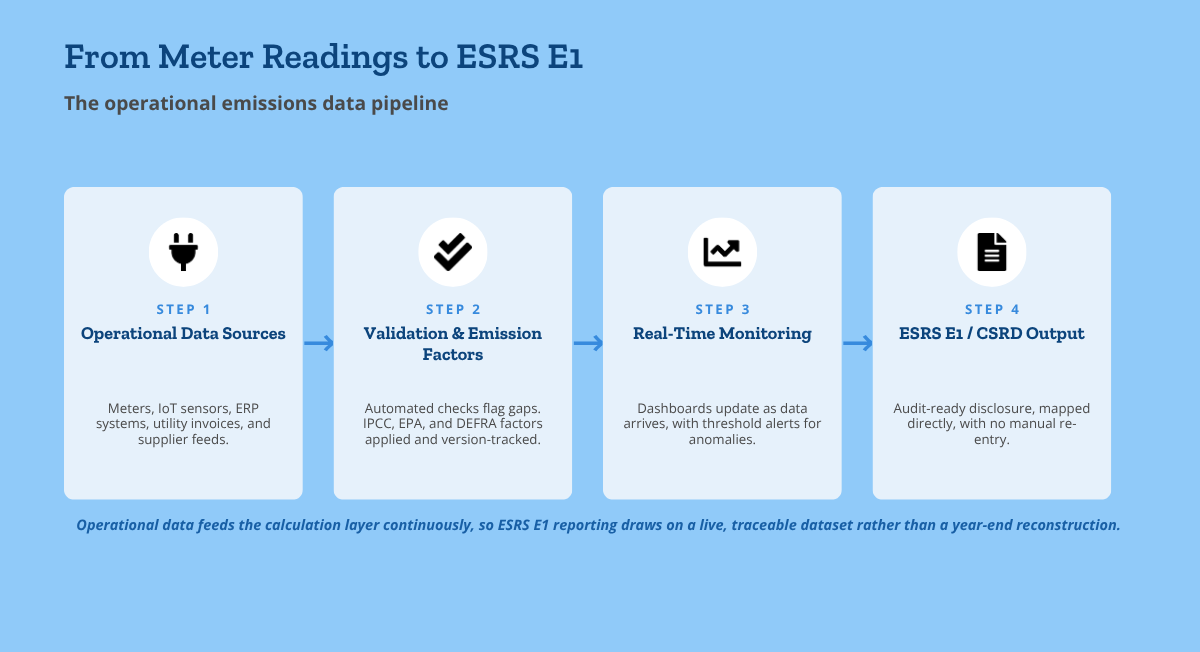
Emissions management software is a category of tools designed to automate the collection, validation, and monitoring of greenhouse gas emissions data from an organisation’s day-to-day operations. Rather than working from a static dataset assembled at year-end, these platforms pull in operational data continuously from meters, sensors, ERP systems, utility invoices, and supplier feeds.
The distinction between emissions management software and carbon accounting software is worth being precise about. Carbon accounting tools (we’ve covered the best carbon accounting software in a separate guide) are generally built around the calculation engine: applying emission factors to activity data and producing GHG Protocol-aligned outputs for disclosure. Emissions management software sits a layer below that. It is concerned with where the data comes from, how reliable it is, and whether it is flowing in close to real time.
In practice, most organisations need both. The operational layer feeds clean, traceable emissions data into the calculation and reporting layer. Without it, even the best carbon accounting tools end up working from estimates rather than activity data.
The core use cases for emissions management software fall into three areas.
- The first is regulatory compliance, particularly under frameworks like the CSRD and its ESRS E1 climate standard, where audit trails matter as much as the final number.
- The second is emission reduction target setting and progress monitoring, since you cannot manage what you cannot measure consistently.
- The third is supplier and value chain data collection, which becomes critical once an organisation starts addressing Scope 3 (our guide to Scope 1, 2, and 3 emissions covers this in detail).
Core Features of Emission Tracking Software
Not every platform marketed as “emissions management software” actually delivers on the operational promise. Here are the capabilities that separate genuinely useful emission tracking software from a reporting template with a different label.
Multi-Source Data Ingestion
The strongest platforms connect directly to meters, IoT sensors, ERP systems, and utility invoices, pulling business activity data in automatically rather than relying on manual uploads. This matters because data collection is consistently the most time-consuming part of emissions management, and the quality of everything downstream depends on it.
Automated Emission Factor Application
Converting raw activity data, such as litres of fuel or kilowatt-hours of electricity, into carbon emissions requires applying the correct emission factor. Good platforms maintain and automatically update emission factor libraries from recognised sources like the IPCC, EPA, and DEFRA, so teams are not manually looking up multipliers for every entry.
Real-Time Dashboards and Alerts
Operational emissions management is fundamentally about visibility between reporting cycles. Dashboards that update as new data arrives, paired with threshold-based alerts, let sustainability and EHS teams catch anomalies (a spike in energy consumption, a missing data feed) while there is still time to act, rather than discovering it during year-end reconciliation.
Scope 1, 2, and 3 Coverage with Method Escalation
Scope 1 and Scope 2 emissions are relatively contained, since they come from owned operations and purchased energy. Scope 3, covering indirect emissions across the value chain, is where most of an organisation’s carbon footprint typically sits. The better platforms support method escalation, starting with spend-based estimates and moving toward activity-based and supplier-specific data as a programme matures, rather than locking teams into one calculation method indefinitely.
CSRD and ESRS E1 Reporting Outputs
Operational data is only useful if it can flow into regulatory reporting without being re-entered or reformatted. Platforms that map operational emissions data directly to ESRS E1 datapoints, and ideally to other frameworks like CDP and GRI from the same dataset, save sustainability teams from duplicating work every reporting cycle.
Top 5 Emissions Management Platforms for EU Businesses (2026)
The platforms below were selected specifically for their operational emissions management capabilities: how they handle data sources, real-time monitoring, and the breadth of emissions they track, rather than purely their reporting templates.
| Platform | Operational Data Sources | Real-Time Monitoring & Alerts | Operational Scope | CSRD/ESRS E1 Output |
|---|---|---|---|---|
| Credibl | Meters, IoT, ERP, invoices, supplier feeds | Yes, with automated validation alerts | GHG-focused, multi-source ingestion | Native |
| Enablon | Meters, facility sensors | Yes, regulatory threshold alerts | Air, water, waste, GHG | Part of Wolters Kluwer’s Corporate Performance & ESG suite |
| Coolset | ERP, utility data, supplier surveys | Dashboard-based, limited real-time | GHG-focused | CSRD-aligned (not native across all ESRS datapoints) |
| Cority | Facility and EHS systems, utility data | Yes, EHS-driven alerts | Air, water, waste, chemical, GHG | Via Cority Sustainability Cloud |
| Sphera | Facility and LCA data, utility feeds | Yes, EHS-driven | Air, water, waste, GHG, LCA | Via SpheraCloud Sustainability |

1. Credibl
Credibl’s emissions management approach is built around a single operational data layer. Meter readings, IoT sensor feeds, ERP exports, utility invoices, and supplier data all flow into one system, where AI-powered ingestion extracts and structures the underlying business activity data automatically.
From there, automated validation flags anomalies and gaps before they become reporting problems, and emission factors are applied and version-tracked against the data they were calculated from. The result is a continuous, audit-ready emissions data trail that feeds directly into ESRS E1 and other framework outputs without manual reformatting.
For EU organisations preparing for the revised ESRS, this operational layer matters more, not less, once mandatory datapoints are reduced. Fewer datapoints means each one needs to be more defensible, and that comes down to how the underlying data was collected and validated in the first place.
2. Enablon
Enablon, part of Wolters Kluwer’s Corporate Performance & ESG division, approaches emissions management from an environmental compliance angle. Its air, water, waste, energy, and chemicals monitoring tools are built to handle facility-level data across multiple geographies, with regulatory threshold alerts that flag deviations before they become compliance issues.
This makes Enablon a strong fit for organisations whose emissions management needs sit alongside broader environmental compliance obligations, particularly in regulated industrial sectors where air quality permits and emissions inventories are managed together.
3. Coolset
Coolset, an Amsterdam-based startup, is built to support CSRD and EU regulatory requirements, including the EU Taxonomy and CBAM alongside emissions tracking. Its data model pulls from ERP systems, utility data, and supplier surveys to support Scope 1, 2, and 3 emissions calculations with method escalation as data quality improves.
Coolset’s strength lies in its CSRD-aligned reporting structure, making it a reasonable fit for mid-market EU organisations whose primary driver is regulatory reporting rather than deep operational monitoring across non-GHG emissions categories.
4. Cority
Cority’s emissions management software grew out of its EHS platform, which means emissions tracking sits alongside chemical management, waste tracking, and workplace safety data in one system. A partnership with Arcadia, announced in February 2025, automates utility data ingestion for Scope 2 reporting, addressing one of the more tedious parts of emissions data collection.
Organisations already running Cority for EHS compliance may find extending into emissions management a natural step, since the operational data infrastructure (facility records, incident data, compliance calendars) is already in place.
5. Sphera
Sphera rounds out this list as the platform with the deepest life cycle assessment (LCA) database among emissions management tools, useful for organisations that need product-level emissions detail alongside corporate-level GHG accounting. Its operational scope extends across air, water, and waste in addition to greenhouse gas emissions, tied to broader operational risk management.
Sphera tends to suit asset-heavy manufacturing and energy businesses already managing complex EHS data, where the implementation overhead is justified by the depth of operational detail required.
Emissions Management Software Across Sectors
Operational emissions management looks different depending on where an organisation’s emissions actually originate. Three sectors illustrate the range.
Manufacturing
For manufacturers, Scope 1 emissions from on-site combustion and process emissions sit alongside Scope 2 from purchased electricity, often across multiple facilities with different equipment and energy sources. Emissions management software that connects directly to meters and production systems gives manufacturers visibility into energy consumption patterns at the line or facility level, which is also where most emission reduction opportunities tend to surface.
Energy
Energy companies face a different challenge: emissions data that spans generation, transmission, and often a portfolio of assets with varying fuel types and vintages. Real-time monitoring matters here not just for compliance, but because energy businesses are themselves often subject to emissions trading schemes, where accurate, timely data has a direct financial dimension.
Logistics
Logistics and transport businesses deal with emissions data that is inherently distributed: vehicles, routes, fuel types, and third-party carriers all contribute to the overall picture. Emissions management software that can ingest fuel card data, telematics, and carrier-reported figures helps logistics companies build a more accurate picture of direct emissions from owned fleets alongside the indirect emissions from contracted transport, an increasingly important Scope 3 category.
Corporate Emissions Management: Integrating ERP, IoT, and Energy Systems
The practical value of emissions management software depends heavily on how well it integrates with the systems that already hold an organisation’s operational data. For most mid-to-large enterprises, that means ERP systems like SAP and Oracle, where procurement, energy, and logistics data already live.
Direct integration with these systems removes one of the biggest sources of friction in emissions management: manual data transfer between finance, operations, and sustainability teams. When emissions data is generated as a by-product of existing ERP workflows, the data collection process stops being a separate exercise and becomes part of how the business already operates.
IoT sensors and smart meters add another layer, particularly for Scope 1 and Scope 2 emissions tied to on-site energy consumption. Facilities with real-time metering can feed consumption data directly into emissions management platforms, replacing estimated or invoice-based figures (which often lag by weeks or months) with near-real-time operational data.
For organisations already invested in Microsoft’s ecosystem, integration with Microsoft Sustainability Cloud is another route worth considering, since it allows emissions data captured at the operational level to flow into the broader data lake and reporting tools many enterprises already rely on for environmental data more generally.
The common thread across all of these integrations is that they reduce the gap between when an emission occurs and when it becomes visible to the teams responsible for managing it. That gap is where data quality problems tend to originate, and closing it is arguably the single biggest lever an organisation has for improving the reliability of its emissions data.
How GHG Emissions Management Software Supports ESRS E1 Compliance
The relationship between operational emissions management and ESRS E1 compliance has become more, not less, important following the 2026 ESRS revisions. With mandatory datapoints set to fall by more than 60 percent under the European Commission’s revised draft standards, the datapoints that remain are expected to carry more scrutiny from auditors and stakeholders, not less.
ESRS E1 requires organisations to disclose gross Scopes 1, 2, and 3 greenhouse gas emissions, energy consumption and mix, and progress against emission reduction targets, among other requirements. Each of these disclosures ultimately traces back to operational data: fuel records, energy bills, production volumes, and supplier-reported figures.
Emissions management software supports ESRS E1 compliance in two ways:
- First, by maintaining a continuous, traceable data trail from source documents (an invoice, a meter reading, a supplier submission) through to the emission factor applied and the final calculated figure. This is the kind of evidence trail that third-party assurance providers look for, and building it incrementally throughout the year is considerably less disruptive than reconstructing it retrospectively.
- Second, by reducing the lag between operational reality and reported figures. Organisations that rely on annual data collection exercises often find that by the time emissions data is compiled for reporting, it reflects operations from many months earlier. Platforms with real-time or near-real-time data ingestion close that gap, giving sustainability teams the ability to monitor progress against emission reduction targets throughout the year rather than discovering shortfalls at reporting time.
“What we consistently hear from sustainability teams is that calculating the number was never the hard part, trusting the data feeding the calculation is. And that’s decided at the point of capture, not at reporting time: iI a meter reading or an ERP export isn’t validated when it lands, no amount of year-end cleanup makes it audit-ready. Under ESRS E1, validating your data as it comes in is what lets you prove your numbers are right when an auditor asks instead of just hoping they are.”
– Deepak Patel, Product Manager at Credibl
For organisations still working out where they sit under the narrowed CSRD scope, the practical advice does not change much.
Whether or not your organisation crosses the 1,000-employee, €450 million threshold directly, customers and partners further up the value chain may still request emissions data aligned to ESRS E1 as part of their own Scope 3 reporting. Building the operational data infrastructure now avoids a scramble later.
See how Credibl connects your operational emissions data to CSRD-ready reporting →
FAQs
What’s the difference between emissions management software and carbon accounting software?
Emissions management software focuses on continuous operational data collection and monitoring from sources like meters, sensors, and ERP systems. Carbon accounting software focuses on calculating and reporting emissions for disclosure, typically working from the data that emissions management tools collect.
Does emissions management software need to support ESRS E1?
For EU companies within CSRD scope, yes. Operational emissions data should be able to map to ESRS E1 datapoints, such as E1-6 for gross Scopes 1, 2, and 3 and total GHG emissions, so that reporting does not require manual reformatting at the end of each cycle. Full coverage of every ESRS datapoint varies by vendor, so it is worth checking each platform’s documentation directly.
How does the 2026 ESRS simplification affect software requirements?
With mandatory datapoints cut by more than 60 percent, the focus shifts toward accuracy and traceability for the datapoints that remain material, rather than breadth of coverage alone.
Can SMEs use emissions management software?
Yes, particularly platforms with lighter implementation models. While the narrowed CSRD scope means fewer SMEs face direct mandatory reporting, many remain in scope indirectly through Scope 3 data requests from larger customers.