

Key Highlights
- Learn what the EU’s latest guidance means for non-EU operators and their emissions monitoring, calculation, and data-management processes.
- Understand how production, energy, process-emissions, and product-level data need to connect to build a defensible CBAM calculation.
- Explore the added complexity of the free-allocation adjustment and the operational data needed to apply it correctly.
- Discover why 2026 is the time to strengthen data controls, rather than trying to reconstruct evidence after the reporting period.
- See how CBAM readiness can create value beyond compliance by supporting product carbon accounting, supply-chain engagement, and broader ESG reporting.
- Learn how digital ESG platforms can help build a more structured, traceable, and verification-ready CBAM data foundation.
The EU’s Latest CBAM Guidance: What’s Included?
On 14 August 2026, the European Commission published a package of 10 guidance documents to support implementation of the Carbon Border Adjustment Mechanism (CBAM) during its definitive period.
The package includes four general guidance documents covering CBAM concepts, non-EU operators, embedded-emissions calculations and the free-allocation adjustment, alongside six sector-specific guides covering cement, hydrogen, fertilizers, iron and steel, aluminum and electricity.
CBAM is moving upstream
The European Commission’s latest CBAM guidance sends a clear signal to businesses around the world: CBAM compliance does not begin at the EU border. It begins much earlier at the production facility.
The new guidance specifically addresses operators of installations outside the EU that produce CBAM goods, providing them with practical direction on emissions monitoring, calculations and reporting. The sector-specific guidance adds another layer by connecting the requirements to actual production processes, value chains and worked examples.
This makes one thing clear: The quality of CBAM compliance will depend heavily on what happens at the source of production. For exporters, the challenge is no longer simply to provide an emissions figure to an EU customer. The underlying data needs to be sufficiently robust, traceable and documented to support the calculation and, where applicable, verification. This is where CBAM starts to look less like a customs requirement and more like an enterprise-wide ESG data challenge.
Existing Scope 1, Scope 2 or Scope 3 accounting approaches cannot simply be transferred into CBAM without considering the specific requirements and boundaries of the regulation. The result is a fundamental shift in how companies need to think about carbon data.

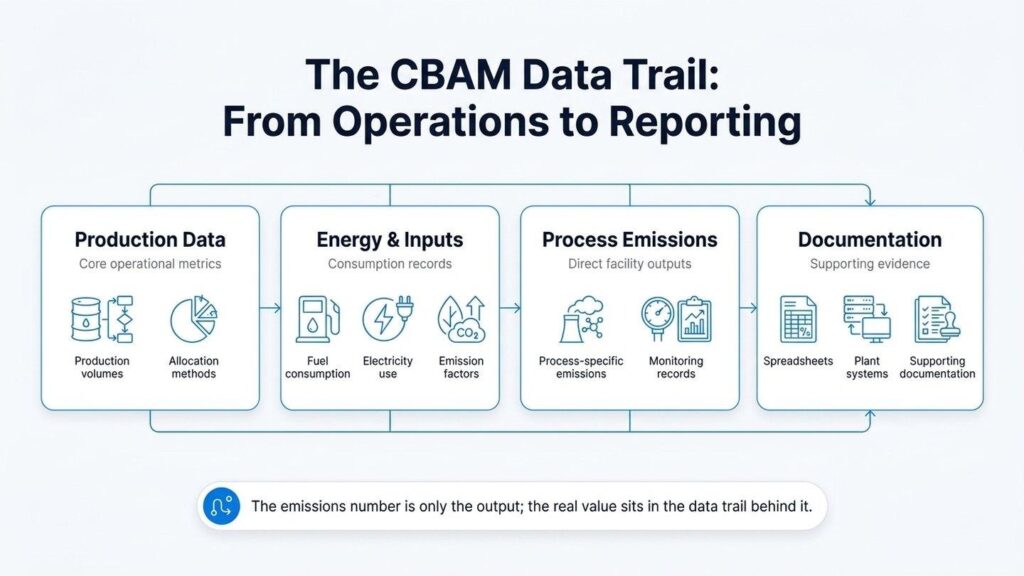
The emissions number is only the output. The real value sits in the data trail behind it, that trail can include production volumes, fuel consumption, electricity use, process emissions, emission factors, allocation methods, monitoring records and supporting documentation. When those elements are fragmented across spreadsheets, plant systems, emails and individual teams, creating a consistent and verification-ready CBAM calculation becomes significantly more difficult. CBAM puts greater emphasis on the quality and consistency of underlying operational information. Energy consumption, production volumes, process activity and emissions-related measurements need to connect with the final product-level calculation.
Practical Guidance on CBAM Roadmap for Non-EU Operators
Latest guidance provides a practical roadmap for non-EU operators producing CBAM goods during the definitive period, with a strong emphasis on building a structured and verifiable emissions-monitoring process at the installation level. It guides operators through developing a monitoring plan, defining production boundaries, tracking direct and relevant indirect emissions, accounting for precursors, determining free-allocation adjustments and applicable carbon prices, and establishing data-flow controls.
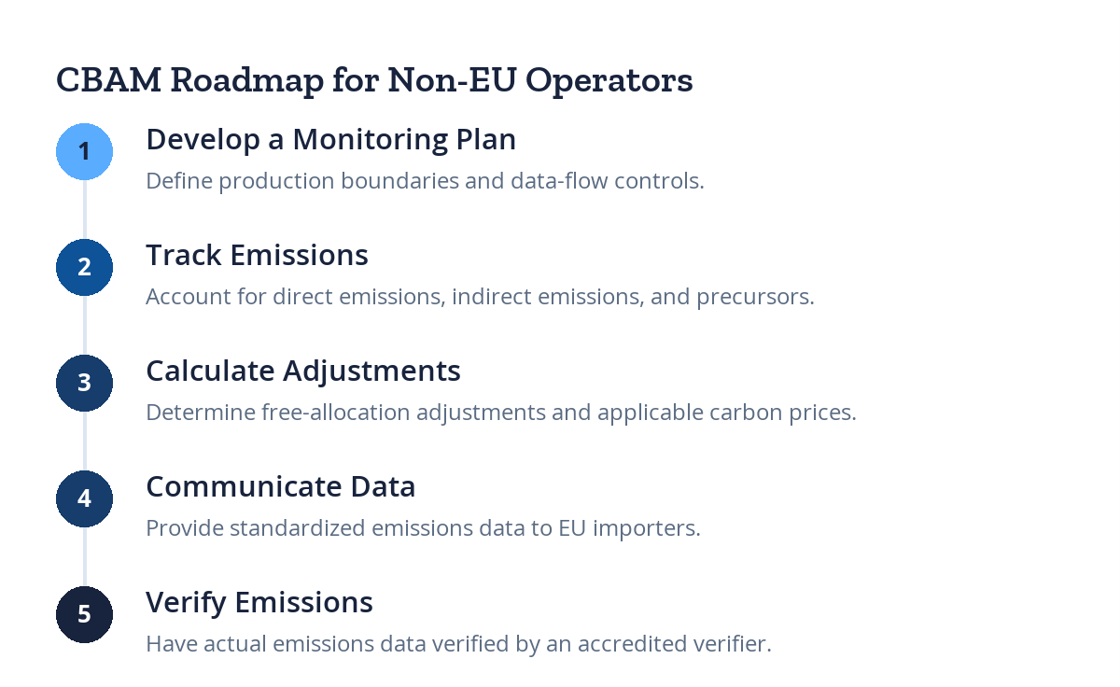
Importantly, the guidance positions monitoring and data governance as continuous processes rather than year-end reporting activities, requiring regular measurement, documentation, quality controls and periodic review of the monitoring plan. It also highlights the importance of communicating standardized emissions data to EU importers and having actual emissions data verified by an appropriately accredited verifier.
Overall, the message is clear: CBAM readiness starts with robust data collection and controls at the installation, long before the final emissions report reaches the EU importer.
Free-allocation adjustment adds another layer
The Commission’s guidance also provides greater clarity around the calculation of the free-allocation adjustment and the information required to determine the number of CBAM certificates to be surrendered. For organizations unfamiliar with the EU ETS framework, this introduces additional complexity.
It also reinforces a broader point: CBAM cannot be treated as a standalone sustainability exercise. Understanding the regulatory requirement is only one part of the process. Organizations also need the right operational data, calculation logic, documentation and controls to apply those requirements consistently.
This is where technology can play an important role. Rather than treating CBAM as another reporting spreadsheet, companies can use the implementation process to strengthen the broader architecture of their carbon data.
2026 is not a preparation year anymore
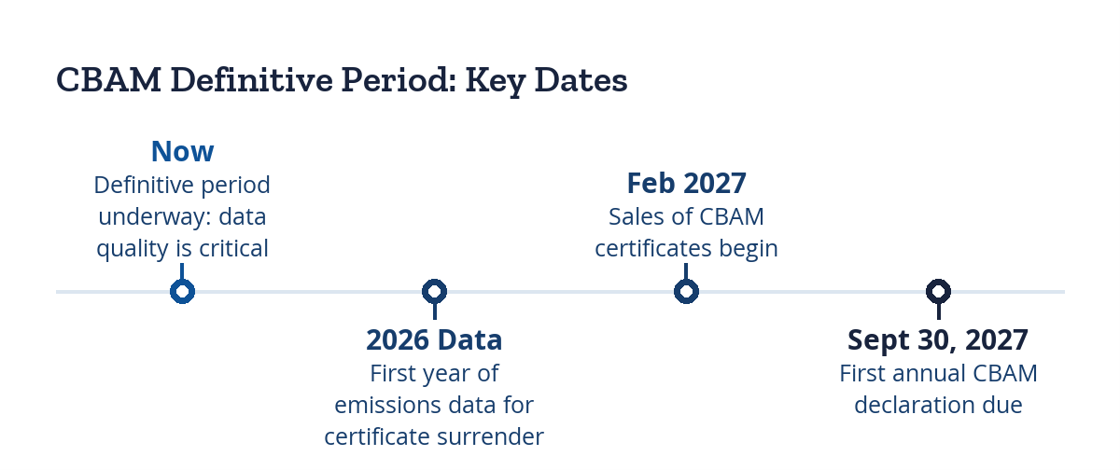
The timing is particularly important. The definitive period is now underway, which means organizations need to focus on the quality of data being generated today, rather than waiting for the reporting deadline.
This is especially relevant for companies that have historically approached emissions data collection as an annual exercise. If meter readings are unavailable, calibration records are incomplete, production data cannot be reconciled with energy consumption, or methodologies have changed without adequate documentation, the problem becomes much harder to solve retrospectively.
You cannot reconstruct reliable evidence for data that was never properly captured. That makes monitoring plans and data controls just as important as the final reporting process. CBAM readiness therefore needs to start at the point where the data is generated not when the report is due.
Why ESG technology platforms matter in the CBAM era
At Credibl ESG, we see CBAM as part of a broader evolution in sustainability management from simply reporting emissions to building confidence in the data behind them. Organizations increasingly need visibility into where their data originates, who owns it, how calculations are performed, which assumptions and emission factors are applied, and what evidence supports the reported figures.
For CBAM-affected organizations, this means bringing operational activity data, emissions calculations, product information, evidence and reporting together within a structured digital environment. The goal is not simply to automate compliance, but to create a trusted digital foundation for carbon data that can support accurate reporting and verification.
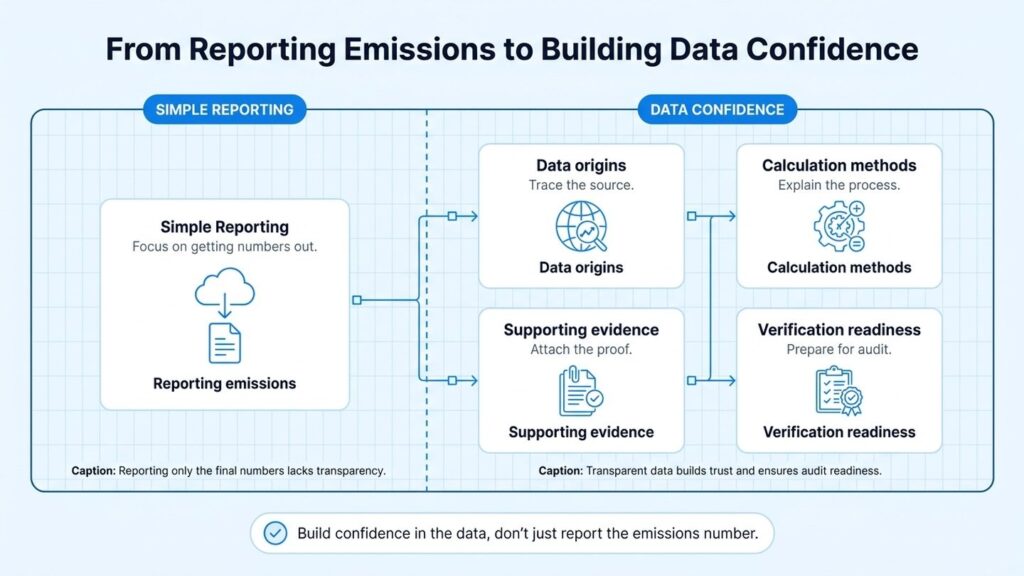
The long-term value of CBAM readiness extends well beyond regulatory compliance. The capabilities organizations develop today such as granular emissions data, traceability, evidence management, data ownership, calculation controls and verification readiness can strengthen product carbon accounting, customer disclosures, supply-chain engagement, decarbonization initiatives and broader ESG reporting.

Compliance may be the immediate driver, but reliable sustainability data is the long-term asset. The latest CBAM guidance reinforces this shift: carbon data is moving closer to the source of production, and as carbon becomes increasingly relevant to international trade, the ability to prove emissions performance could become just as important as improving it.
A final thought
The latest CBAM guidance provides greater clarity on how businesses can build this capability, particularly through its structured approach to monitoring plans, emissions data collection, calculation methodologies, data controls, reporting and verification. For non-EU operators, this creates a clearer pathway from understanding CBAM requirements to putting the right processes and data systems in place.
CBAM is bringing sustainability data closer to the factory floor, the production process and the individual product, making carbon accounting less of a year-end reporting exercise and more a part of an organization’s underlying operational and data processes. Technology platforms such as Credibl ESG can help organizations bring these fragmented data points together, strengthen traceability and establish a more consistent, verification-ready carbon data foundation.
For businesses, this is an opportunity to build capabilities that extend well beyond CBAM compliance. The companies that establish this capability now will be better positioned not only for CBAM, but for a global economy where credible carbon data increasingly influences how products are made, traded and valued.

As the latest guidance brings greater structure and clarity to the CBAM implementation journey, digital ESG platforms can play an important role in turning these requirements into practical, scalable data processes. We’d love to hear from sustainability, operations and supply-chain professionals navigating this transition- let’s hear what you’re seeing on the ground.
Frequently Asked Questions
1. How will I get access to the CBAM Registry?
Once an importer’s application has been authorized by the competent authority, they are considered an authorized CBAM declarant. Each authorized CBAM declarant is assigned a CBAM account number by the Commission, which then allows access to the CBAM registry. The access management is performed via the EU-wide UUM&DS.
This means that declarants have the ability to access the CBAM Definitive system using either Option 1 (CBAM Domain) or Option 2 (Customs Domain), depending on the choice made by the national authorities. New UUMDS profiles are required for the definitive registry. NCAs need to assign these new profiles to existing declarants to ensure their access to the definitive system.
Third-country operators are also able to access the CBAM Registry. Third-country operators use the Commission’s DG DIGIT’s EU-Access platform to access the CBAM 21 portal. The Commission validates access requests from third-country operators and grant access where appropriate. If access to the platform needs to be revoked, the Commission consults Member States.
2. Which sectors are applicable to the CBAM?
CBAM applies to imports of goods in the following sectors: Cement, Iron and Steel, Aluminum, Fertilizers, Hydrogen, Electricity. These sectors were selected following specific criteria, in particular their high risk of carbon leakage and high emission intensity which will eventually – once fully phased in – represent more than 50% of the emissions of the sectors covered by the ETS. In the future, the CBAM may be extended to other ETS sectors.
3. Which third countries fall under the scope of the CBAM?
The CBAM applies to a selected number of goods whatever their country of origin. The only exception is goods originating from third countries who participate in the EU ETS (i.e. non-EU members of the European Economic Area (EEA), Iceland, Lichtenstein and Norway) or have an emission trading system linked to the EU ETS (i.e. Switzerland).
4. When do I have to submit the CBAM declaration?
Authorized CBAM declarants must submit an annual CBAM declaration by 30 September following the year where the goods covered by that declaration were imported, in accordance with Article 6 of Regulation (EU) 2023/956.
5. When and how will declarants buy CBAM certificates?
Sales of CBAM certificates will start in February 2027. Declarants can buy the number of CBAM certificates which corresponds to the emissions embedded in the CBAM goods they imported in 2026 into the EU on the CCP from February 2027 and before 30 September 2027.
6. Can CBAM certificates be transferred or sold to another person?
No. CBAM certificates are to be used by the purchasing authorized CBAM declarant. They cannot be transferred nor sold to another person, even if that person is an entity which belongs to same group as the entity holding the authorization.